A custom LED display may be designed as a sphere, cylinder, bottle, ring, wave, or another irregular shape. The visible structure is often unique, but this does not mean every part inside the screen should also be unique.
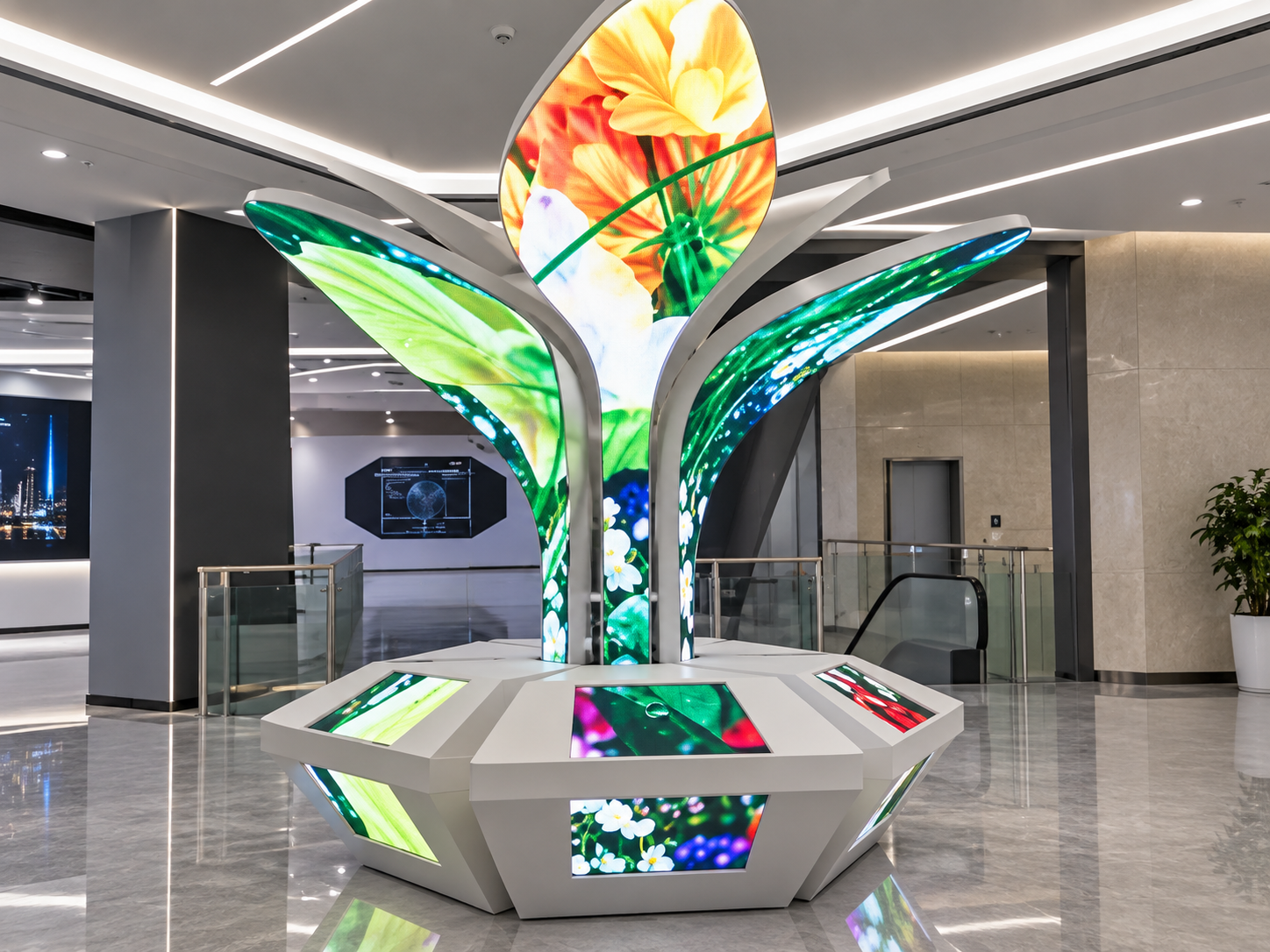
In fact, using too many different components can make future maintenance unnecessarily expensive.
A useful design principle is simple:
Keep the visible geometry custom, but standardize as many hidden service parts as possible.
This can reduce the number of spare parts, simplify troubleshooting, and make repairs faster several years after installation.
During production, using several different components may not appear to be a major issue.
The real problem often appears later.
Imagine a custom LED screen that uses four types of power supplies, three receiving card models, several connector types, and different cable lengths or pinouts in different sections.
When one part fails, the maintenance team first has to identify the correct version. The customer must also keep more spare parts in storage.
For a single screen, this may only be inconvenient. For a shopping mall, exhibition company, hotel group, or AV integrator managing several LED installations, the cost can become much higher.
Therefore, reducing maintenance cost is not simply about buying more spare parts.
It is also about reducing the number of unique parts that need to be stocked.
Power supplies are one of the first components engineers should try to standardize.
If the electrical load allows it, using the same power supply model across multiple sections makes replacement much easier.
The maintenance team does not need to store several similar units or spend time checking which version belongs to which area.
Standardization can also make power distribution diagrams easier to understand.
However, engineers should still calculate the actual load of each section. A small neck section of a bottle-shaped LED display and a large main body may not have exactly the same power requirement.
The goal is not to force one component into every position. It is to reduce unnecessary variations.
Receiving cards are another important part to standardize.
A custom-shaped LED display can contain many receiving cards because the screen may be divided into several irregular areas.
Using completely different receiving card models in different sections makes future replacement and configuration more complicated.
Where possible, engineers should use the same receiving card family and keep similar firmware and configuration methods.
This makes it easier to prepare spare cards and helps technicians diagnose faults without learning several different systems.
The saved configuration files should also be clearly named and stored with the project documentation.
Hardware standardization without configuration management only solves half of the problem.
Cables are inexpensive compared with LED modules or control equipment, but they can cause surprisingly long maintenance delays.
Different connectors or different pin arrangements can easily create confusion inside a complicated custom structure.
Whenever possible, a project should use consistent:
power connectors;
signal connectors;
cable pinouts;
cable labels;
connection directions.
The cables can still have different lengths where the geometry requires it.
What should remain consistent is the connection logic.
Clear numbering also matters. If Module A12 connects to Receiving Card R03, the same information should appear on the physical label and project drawing.
A technician should not need to trace every cable again during a repair.
LED modules require a different approach.
Using one standard module size can greatly reduce spare-part inventory, but custom LED displays often contain curves, corners, transitions, or narrow sections that cannot be created with one rectangular module.
For example, the main body of a cylindrical LED screen may use repeated flexible LED modules, while its upper or lower transition area requires another design.
Trying to force a standard module into every area can create large seams, poor curves, or mechanical stress.
A better strategy is to use the smallest practical number of module types.
If 80% of the screen can use one module and only 20% requires special modules, the maintenance system is already much simpler than a design containing many unique module sizes.
The supporting frame itself usually needs to follow the custom shape.
A spherical frame cannot be standardized in exactly the same way as a flat LED wall.
But the method used to fix and remove modules can often be standardized.
For example, engineers can use consistent screw sizes, magnetic fixing points, service tools, mounting brackets, or module release methods.
This small decision can save time during maintenance.
A technician working at height or inside a narrow service space should not need five tools to remove five nearby components.
Standardization is useful, but too much standardization can damage the original design.
Some parts should remain project-specific, including:
curved supporting frames;
sphere skeleton structures;
bottle shoulder and neck sections;
special transition modules;
edge modules;
unusual PCB geometry;
architectural mounting structures.
These parts control the actual shape of the LED display.
The objective is therefore not maximum standardization.
The better target is:
the minimum number of unique service parts without compromising the required shape.
A custom LED display should not only be tested for image quality before shipment.
The maintenance process should also be tested.
During factory assembly, engineers can intentionally remove one LED module, one receiving card, and one power supply.
They can then check:
How long does removal take?
Which tools are required?
Can the correct spare part be identified quickly?
Are connectors easy to reach?
Are cables clearly labeled?
Can the replacement part be installed without removing unrelated sections?
Can the original configuration be restored quickly?
This type of maintenance test can reveal problems that normal video testing will not show.
A display may look perfect while operating but still be difficult to repair.
Consider a large cylindrical LED installation in a commercial space.
The shape is custom, but most of the body uses repeated flexible LED modules. The project uses one receiving card family, one main power supply model, common connectors, consistent cable labeling, and the same module fixing method throughout most of the structure.
Only the top transition section requires special modules and structural parts.
Years later, if a receiving card fails, the maintenance team can use a standard spare rather than searching for a rare project-specific model.
That is where standardization produces real value.
It does not make the display less customized.
It makes the customized display easier to own.
No. Structural parts and special modules may need to follow the actual shape. Components should only be standardized when doing so does not reduce structural accuracy or visual quality.
Power supplies, receiving cards, connectors, cable pinouts, fasteners, module fixing methods, and commonly used LED modules are usually good places to start.
Not always. Its biggest advantage is often lower long-term maintenance complexity, fewer spare-part models, and faster replacement.
Whenever practical, spare modules should be prepared with the project because differences between production batches can affect visual consistency after replacement.
A good custom LED display should look unique from the outside without becoming unnecessarily complicated inside.
At AILED, we provide creative and custom-shaped LED display solutions for projects including spherical, cylindrical, bottle-shaped, curved, and other irregular LED structures.
During project development, the screen shape, LED modules, control system, supporting structure, wiring, maintenance access, and factory testing can be planned together according to the real installation environment.
For buyers, designers, and AV integrators, the best custom LED solution is not only one that looks impressive on installation day. It should also remain practical to service years later.
Visit AILED Display to learn more about custom-shaped LED display solutions and discuss your project requirements.
 Hot News
2026-09-15
2026-09-14
2026-09-11
Copyright © 2025 by Shenzhen Ai Display Technology Co., Ltd - Privacy policy
 EN
EN