Elevator lobbies are busy spaces where people need to make quick decisions. Visitors look for elevator numbers, floor directions, and exit signs while moving through the building. Adding a flexible LED display can make the lobby more attractive, but poor screen placement may create confusion.
A successful design should improve the space without making navigation difficult. This requires careful planning of screen position, brightness, content, and installation structure.
People usually spend only a short time in an elevator lobby. They need to find the correct elevator, understand which floors it serves, and move safely.
A large LED screen can easily attract attention away from important signs. Moving graphics may also make elevator indicators harder to notice.
This can cause several problems:
Visitors may walk toward the wrong elevator.
Floor numbers and directional signs may become difficult to read.
Bright animations may distract people near elevator doors.
Crowded areas may experience slower pedestrian movement.
These issues are especially important in hotels, hospitals, shopping malls, and office buildings where many visitors are unfamiliar with the layout.
The main problem is often the relationship between the LED display and existing wayfinding signs.
For example, a bright screen installed directly above elevator doors may compete with floor indicators. If its content includes moving arrows or large numbers, visitors may mistake these graphics for navigation information.
Reflective wall materials can make the situation worse. Light from the screen may create glare on metal panels or polished surfaces.
Another common issue is using too much information. Fast-changing advertisements, detailed text, and strong color transitions can overwhelm visitors in a small lobby.
The solution starts with understanding how people see and use the space.
Flexible LED displays work well on curved walls, rounded columns, and other surfaces where traditional flat screens may not fit.
However, the display should not interfere with essential navigation.
Keep directional signs clearly visible. Elevator numbers, emergency exits, and floor information must remain easy to identify.
Use secondary wall areas. Curved side walls or decorative columns are often better locations than surfaces directly above elevator doors.
Control screen brightness. Indoor brightness should match the surrounding lighting. Excessive brightness can create discomfort, especially in smaller lobbies.
Choose simple content. Slow animations, brand visuals, and welcome messages are generally easier to understand than rapidly changing graphics.
The goal is to create an attractive display that supports the lobby design while keeping navigation simple.
Testing helps identify problems before the screen becomes a permanent part of the building.
Start by checking the display from different entrance points. Visitors should still recognize elevator signs immediately.
Next, test the content under normal daytime and evening lighting conditions. Adjust brightness when necessary.
A practical test should include:
Checking whether elevator numbers remain readable.
Viewing the screen from different walking directions.
Testing animations for possible distractions.
Checking reflections on nearby walls and doors.
Confirming that emergency signs remain visible.
It is also helpful to ask someone unfamiliar with the building to find a specific elevator. Their experience may reveal problems that the design team has overlooked.
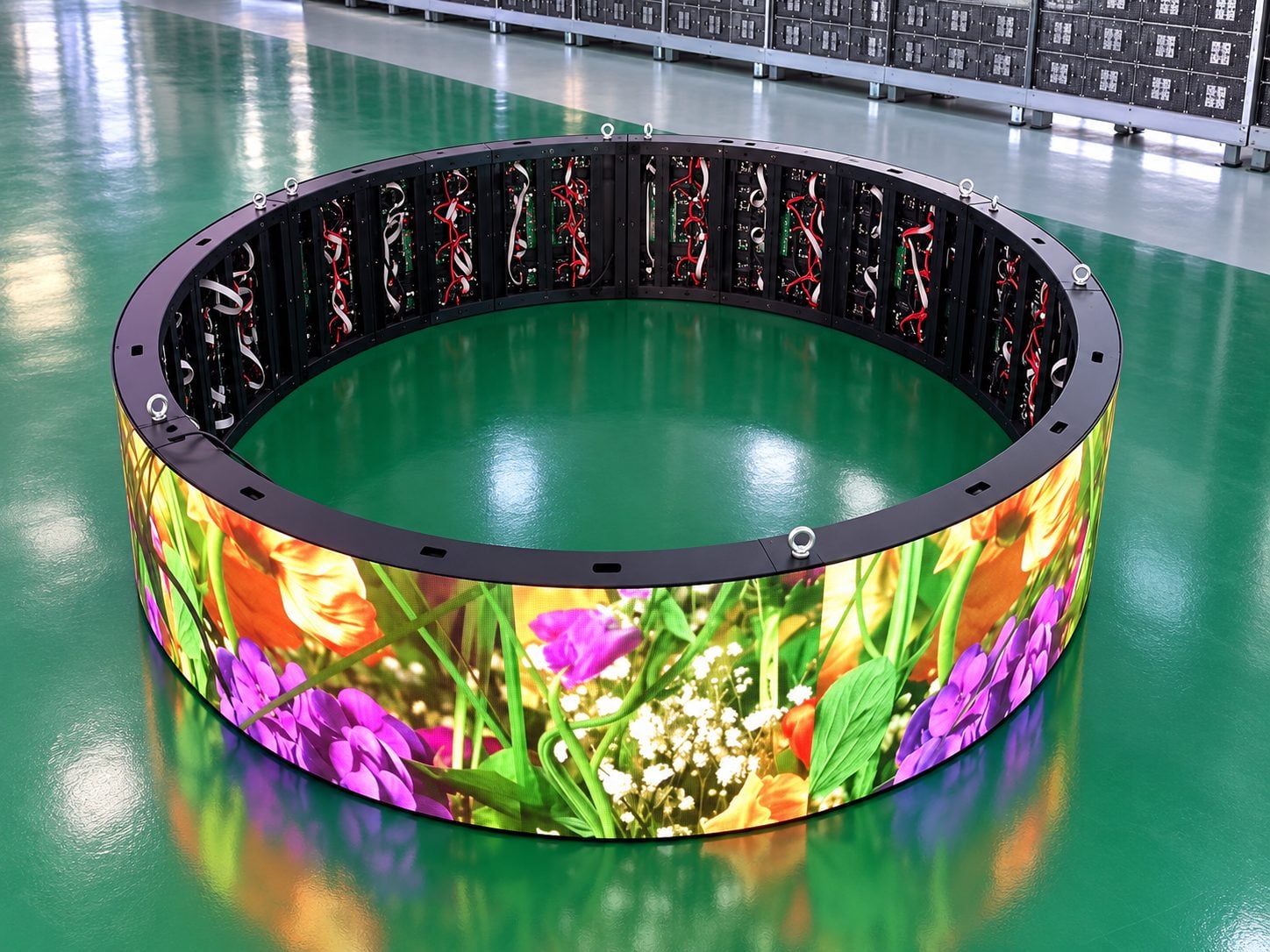
Flexible LED modules allow screens to follow curved surfaces, but the supporting structure is equally important.
For close viewing distances, a smaller pixel pitch generally produces clearer images. The final choice should depend on viewing distance, content requirements, and budget.
The mounting frame must match the wall's shape while maintaining accurate module alignment.
Other important components include:
Reliable power supplies and receiving cards.
Proper ventilation and heat management.
Accessible connections for future maintenance.
Suitable mounting brackets and cable protection.
A control system that supports scheduled content and brightness adjustment.
Maintenance access should be considered during the design stage. A beautiful curved installation can become expensive to service if modules cannot be removed easily.
Consider an office building with six elevators arranged along a curved wall.
Instead of placing one continuous LED screen above all elevator doors, the designer installs flexible LED modules on a separate curved feature wall.
The screen displays company branding, welcome messages, and slow-moving abstract patterns.
Elevator numbers remain clearly visible above each door, while directional signs use consistent colors and typography.
During busy morning hours, the display runs simple, low-motion content. At quieter times, it can show more detailed promotional information.
This example shows how flexible LED displays can improve the appearance of a lobby without interfering with daily movement.
Can flexible LED displays be installed on elevator lobby columns?
Yes. Flexible modules can follow certain curved surfaces, provided the column diameter and module bending limits are suitable.
What content works best in elevator lobbies?
Welcome messages, building announcements, brand graphics, and slow animations are good options. Avoid content that resembles directional signs unless it is part of an approved wayfinding system.
Should elevator lobby LED screens operate continuously?
They can operate for extended periods when properly designed. Brightness schedules, ventilation, and regular maintenance help support reliable operation.
Elevator lobby projects require more than selecting a screen size. The supplier must understand curved installation surfaces, module compatibility, mounting accuracy, and maintenance requirements.
Shenzhen Ai Display Technology Co., Ltd. provides LED display solutions, including indoor and custom-shaped displays. The company supports projects through product design, manufacturing, engineering guidance, and after-sales service.
For elevator lobby projects, sharing wall dimensions, curvature details, viewing distances, and installation drawings early can help the technical team recommend a suitable display configuration.
A well-designed flexible LED display should make the elevator lobby more welcoming while allowing every visitor to find the right direction with confidence.
 Hot News
Copyright © 2025 by Shenzhen Ai Display Technology Co., Ltd - Privacy policy
 EN