
A roadshow often takes an LED display through several cities, exhibition halls, shopping malls, and event venues. Unlike a fixed LED installation, the screen may need to be transported, assembled, operated, and dismantled several times within a short period.
For event organizers and rental companies, keeping the display running is just as important as its image quality. A black screen, unstable signal, or damaged module during a live presentation can interrupt the event and affect the brand's image.
So, how can businesses reduce downtime when using customized LED displays for roadshows? The key is to prepare a maintenance plan before the first event instead of waiting until a problem appears.
Roadshow schedules are usually tight. An event team may finish a presentation in one city and move to another location the next morning.
There is often little time for equipment inspection or unexpected repairs.
If an LED display develops a problem during this process, technicians may need to identify the faulty component, find a replacement, and complete the repair before the next presentation.
Without proper maintenance planning, even a small technical issue can delay the entire schedule.
Several problems are more likely to appear when LED displays are used repeatedly for roadshows.
Transportation damage: Frequent loading and unloading can cause scratches, loose connectors, damaged cabinet corners, or internal component problems.
Loose connections: Repeated assembly may affect power cables, signal cables, locking systems, and connection points.
Power supply problems: Unstable input voltage, overloaded circuits, or aging power supplies can cause flickering, black sections, or unexpected shutdowns.
Overheating: Dust accumulation and poor ventilation may affect the operating temperature of power supplies and control components.
Missing spare parts: A damaged module or receiving card can take much longer to replace if compatible components are not available on site.
These problems are often preventable with regular inspection and proper equipment management.
A practical maintenance plan should follow the entire event cycle.
Before transportation
Check LED modules for dead pixels and visible damage.
Inspect cabinet corners, handles, locks, and connectors.
Test power supplies and signal cables.
Confirm that flight cases provide enough protection.
Prepare spare modules and essential tools.
After installation
Check cabinet alignment and connection stability.
Test all power and signal lines.
Play different colors and video content across the entire screen.
Check brightness and color consistency.
Run the display continuously before the event begins.
After each event
Turn off the display according to the operating procedure.
Inspect modules, cables, and cabinet connections.
Clean dust from accessible areas when appropriate.
Record any faults or unusual operating conditions.
Replace damaged components before the next transportation.
This routine helps technicians identify small problems before they become serious failures.
One of the simplest ways to reduce LED screen downtime is to prepare compatible spare parts.
For customized LED displays, the required components depend on the screen structure and control system.
A practical spare parts kit may include:
LED modules for the main display.
Power supplies for quick replacement.
Receiving cards and spare data cables.
Power cables and signal connectors.
Locking accessories and basic installation tools.
The quantity should depend on the screen size, number of units, transportation frequency, and previous maintenance records.
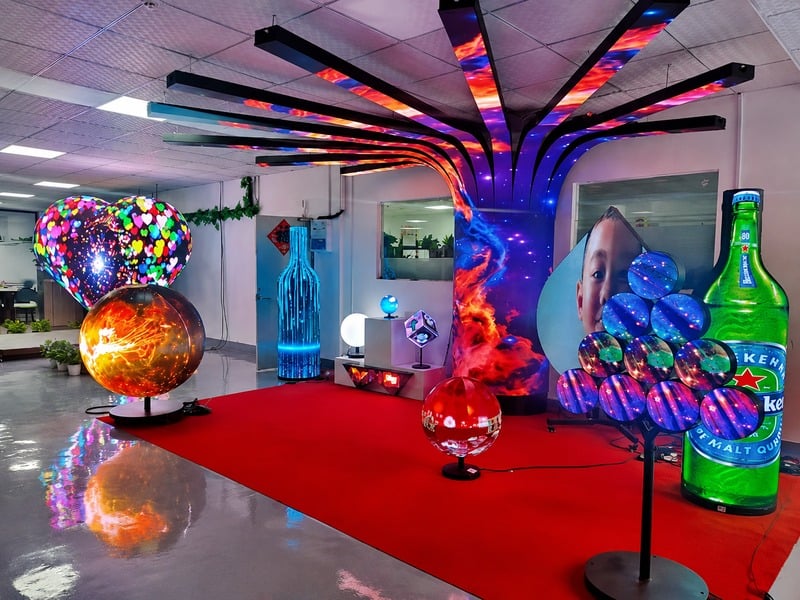
For irregular-shaped displays, spare modules should be selected according to their exact positions and specifications. A standard rectangular module may not fit a curved, spherical, or cylindrical structure.
Keeping spare parts from the original production batch can also help maintain color consistency after replacement.
A screen that worked perfectly at the previous venue does not automatically guarantee reliable operation at the next one.
Before each roadshow, technicians should complete a basic inspection.
First, power on the complete display and check whether all modules light up normally.
Second, test different colors, including red, green, blue, white, and black. This helps identify dead pixels, uneven brightness, and color differences.
Third, play actual event content to check video playback, signal transmission, and image stability.
Finally, monitor the display during continuous operation to identify unexpected shutdowns or overheating.
For events involving live cameras, it is also useful to check refresh rate and camera compatibility in advance.
Maintenance should be considered when selecting a customized LED display, not only after installation.
For example, front-maintenance modules can make repairs easier when rear access is limited. Modular cabinet designs can also simplify transportation, assembly, and replacement.
Other important details include:
Accessible power supplies and receiving cards.
Clearly labeled power and signal connections.
Reliable cabinet locking systems.
Suitable ventilation and heat dissipation.
Customized flight cases for repeated transportation.
For spherical, curved, cylindrical, and other irregular-shaped LED displays, engineers should also plan maintenance access around the actual structure.
A creative display should not become difficult to repair simply because of its unusual shape.
Consider a brand promotion company organizing a roadshow across several shopping malls in different cities.
The company uses customized LED displays to present promotional videos and product information. Each event requires the equipment to be transported, installed, operated, and dismantled within a limited schedule.
To reduce unexpected downtime, the technical team prepares a maintenance checklist before the first event. Spare modules, power supplies, signal cables, and basic tools travel with the equipment.
After each presentation, technicians inspect the cabinets and connections before packing everything into protective flight cases.
At the next venue, they complete a full power-on and content test before the event starts.
This approach helps the team identify potential problems early and reduces the risk of last-minute repairs.
Q1: How often should customized LED displays be maintained during roadshows?
Basic inspections should be performed before and after each event. More detailed checks should follow the manufacturer's maintenance recommendations and the actual operating conditions.
Q2: Which spare parts are most important for roadshow LED screens?
LED modules, power supplies, receiving cards, power cables, and signal cables are among the most useful spare components.
Q3: How can event companies reduce LED screen repair time?
Prepare compatible spare parts, label cables and modules, keep maintenance tools available, and train technicians to identify common faults.
At AILEDDISPLAY, we provide LED display solutions for stage events, exhibitions, roadshows, commercial promotions, and other professional applications.
Our product range includes rental LED displays, spherical LED screens, and customized shaped LED displays. With in-house production, CNC processing technology, and an experienced engineering team, we focus on structural accuracy, product quality, and practical installation requirements.
Whether you need a portable rental LED screen or a customized display with a unique structure, AILEDDISPLAY can help you evaluate a suitable solution based on your project requirements.
Visit www.aileddisplay.com to explore our LED display products and discuss your next roadshow project.
Copyright © 2025 by Shenzhen Ai Display Technology Co., Ltd - Privacy policy
 EN

 Hot News