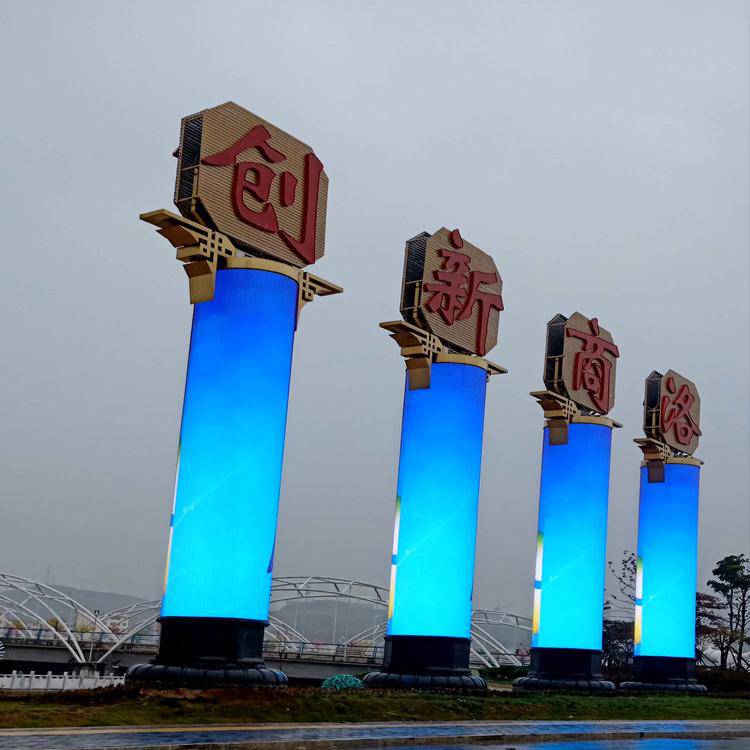
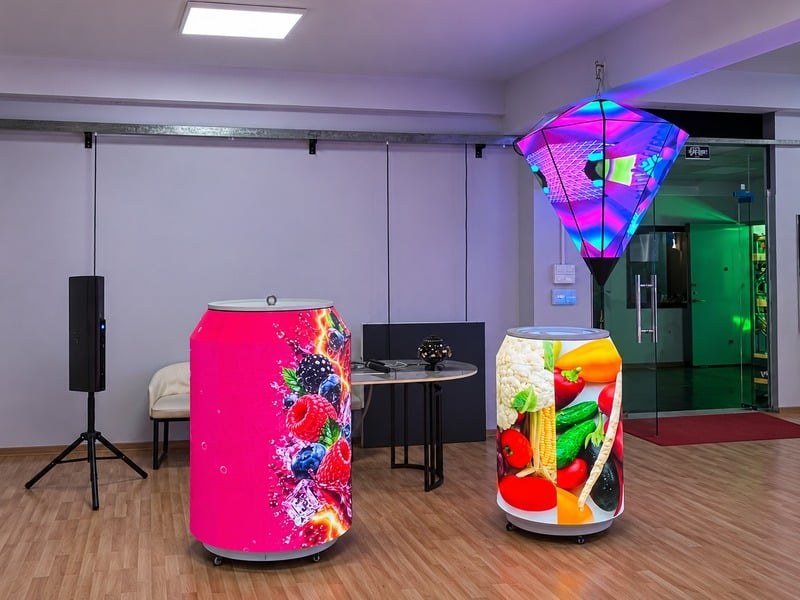
A customized shaped LED screen is designed to fit a specific space, structure, or visual concept. Unlike traditional rectangular LED displays, it may have a curved surface, circular design, cylindrical body, or completely irregular shape.
However, an attractive screen design does not always guarantee clear images. One important factor is pixel density. If the pixel pitch is too large for the actual viewing distance, viewers may notice individual pixels, rough text edges, and unclear image details. On the other hand, choosing an unnecessarily small pixel pitch can increase project costs without providing a meaningful improvement.
So, how should buyers evaluate pixel density for customized shaped LED screens? The answer depends on the relationship between pixel pitch, viewing distance, screen geometry, and content requirements.
Pixel density refers to the number of pixels within a specific display area. For LED screens, it is closely related to pixel pitch, which measures the distance between the centers of two neighboring pixels.
A smaller pixel pitch means more pixels are placed within the same area, resulting in higher pixel density and potentially finer image details.
For example, a P2 LED display has approximately 250,000 pixels per square meter, while a P4 display has approximately 62,500 pixels per square meter.
This difference becomes important when displaying small text, product images, facial details, and high-resolution videos.
For customized shaped LED screens, the challenge is more complex because the display surface may not be flat. Curved and irregular structures can also affect how viewers perceive image details from different positions.
Selecting an unsuitable pixel density can create several visible problems.
Visible pixel structure: When viewers stand too close to a screen with a large pixel pitch, individual LED pixels become noticeable.
Unclear text and graphics: Small letters, logos, and detailed patterns may appear rough or difficult to recognize.
Reduced image quality: High-resolution video content cannot show all its details if the physical screen resolution is insufficient.
Uneven viewing experience: On curved or spherical displays, people standing at different positions may notice different levels of detail.
These problems can reduce the overall visual quality, especially in retail stores, museums, exhibitions, and other environments where visitors can approach the screen closely.
Pixel density should not be selected according to one specification alone.
Viewing distance
This is usually the first factor to evaluate. A screen installed two meters from the audience generally needs a finer pixel pitch than one viewed from ten meters away.
As an initial reference, engineers often use the pixel pitch in millimeters as an approximate minimum viewing distance in meters. For example, P2 may be considered for viewing from around two meters.
However, this is only a preliminary guideline. Actual requirements depend on content, eyesight, installation conditions, and project expectations.
Screen geometry
A flat LED screen provides a relatively consistent viewing surface. A spherical, cylindrical, or curved display has different viewing angles and surface orientations.
Therefore, engineers should consider the screen's complete geometry rather than evaluating only its front-facing area.
Content requirements
Large animated graphics and simple promotional videos do not require the same detail level as small text, product descriptions, or detailed brand logos.
The more detailed the content, the more carefully pixel pitch and resolution should be evaluated.
Screen dimensions
A larger customized LED display may contain more total pixels, but its physical size alone does not determine image clarity. The relationship between pixel pitch and viewing distance remains important.
The following table provides a preliminary reference for indoor projects.
| Pixel Pitch | Pixel Density | Typical Viewing Distance |
|---|---|---|
| P1.5 | 444,444 pixels/m² | Around 1.5m |
| P2 | 250,000 pixels/m² | Around 2m |
| P2.5 | 160,000 pixels/m² | Around 2.5m |
| P3 | 111,111 pixels/m² | Around 3m |
| P4 | 62,500 pixels/m² | Around 4m |
| P5 | 40,000 pixels/m² | Around 5m |
These values are based on a standard square pixel arrangement. They are reference figures, not guaranteed optimal viewing distances.
For example, a P2.5 customized LED display may be suitable for a shopping mall installation where visitors watch from several meters away. A P1.5 or P2 solution may be more appropriate for a showroom where viewers frequently stand close to the screen.
The final selection should be confirmed through actual content testing.
Technical specifications alone cannot fully predict the viewing experience. A practical evaluation process is recommended.
First, confirm the minimum and maximum viewing distances based on the installation layout.
Second, prepare sample content containing small text, straight lines, logos, faces, and detailed images.
Third, display the content on a representative LED module or sample screen using the proposed pixel pitch.
Fourth, inspect the image from several positions, including the closest viewing point, the main audience area, and both sides of the display.
For curved and spherical screens, engineers should also check whether important details remain recognizable when viewers move around the display.
Finally, review the actual pixel layout and content resolution to ensure that the selected control system can support the required display configuration.
This process helps buyers identify potential limitations before customized modules and supporting structures enter production.
Different customized shaped LED screens require different module configurations.
For example, custom-shaped LED screens can be designed for irregular structures and creative commercial installations.
Spherical LED screens are suitable for 360-degree visual applications, while cylindrical LED displays can create continuous images around curved surfaces.
The complete display system may include LED modules, customized cabinets, receiving cards, video processors, power supplies, signal cables, and supporting structures.
All these components should be considered during project planning to ensure that the selected pixel pitch works with the actual screen design.
Consider a customized cylindrical LED screen installed in a shopping mall.
Visitors may approach the display from different directions and at different distances. If the screen mainly shows large promotional animations, P2.5 or P3 may provide sufficient visual performance.
However, if the display presents product information, small text, or detailed brand graphics, a finer pixel pitch may be necessary.
For exhibition projects, spherical LED displays also require careful evaluation because audiences can view the screen from multiple directions.
The best configuration is not necessarily the one with the highest pixel density. It is the one that delivers the required image detail under actual viewing conditions.
Q1: Does higher pixel density always mean better image quality?
Not necessarily. Higher pixel density can improve fine details, but content resolution, video processing, screen geometry, and viewing distance also affect image quality.
Q2: How do I calculate LED pixel density?
For a standard square pixel arrangement, the approximate pixel density per square meter is 1,000,000 divided by the square of the pixel pitch in millimeters.
Q3: Can customized shaped LED screens use different pixel pitches?
Yes. Different projects can use different pixel pitches depending on screen size, viewing distance, structure, and budget.
Q4: Should pixel pitch be confirmed before customized production?
Yes. It should be confirmed during the design stage to avoid resolution limitations and unnecessary changes after production.
Choosing the right pixel density requires more than comparing technical specifications. It involves understanding the installation environment, viewing distance, screen geometry, and expected content.
AILEDDISPLAY provides customized LED display solutions, including spherical, cylindrical, flexible, and other irregular-shaped LED screens.
From LED module selection and structural design to control system configuration and production, our team works with customers to develop display solutions based on actual project requirements.
Before requesting a quotation, customers can provide screen dimensions, reference pictures, installation drawings, expected viewing distances, and content requirements. These details help our engineering team recommend a suitable pixel pitch and display configuration.
Visit www.aileddisplay.com to explore customized LED display solutions.
 Hot News
2026-11-27
2026-11-26
2026-11-25
Copyright © 2025 by Shenzhen Ai Display Technology Co., Ltd - Privacy policy
 EN