A bottle-shaped LED display may look perfect during the first screen test. The brand logo is clear, the animation runs smoothly, and the bottle outline matches the design. However, the final result can change after decorative finishing.
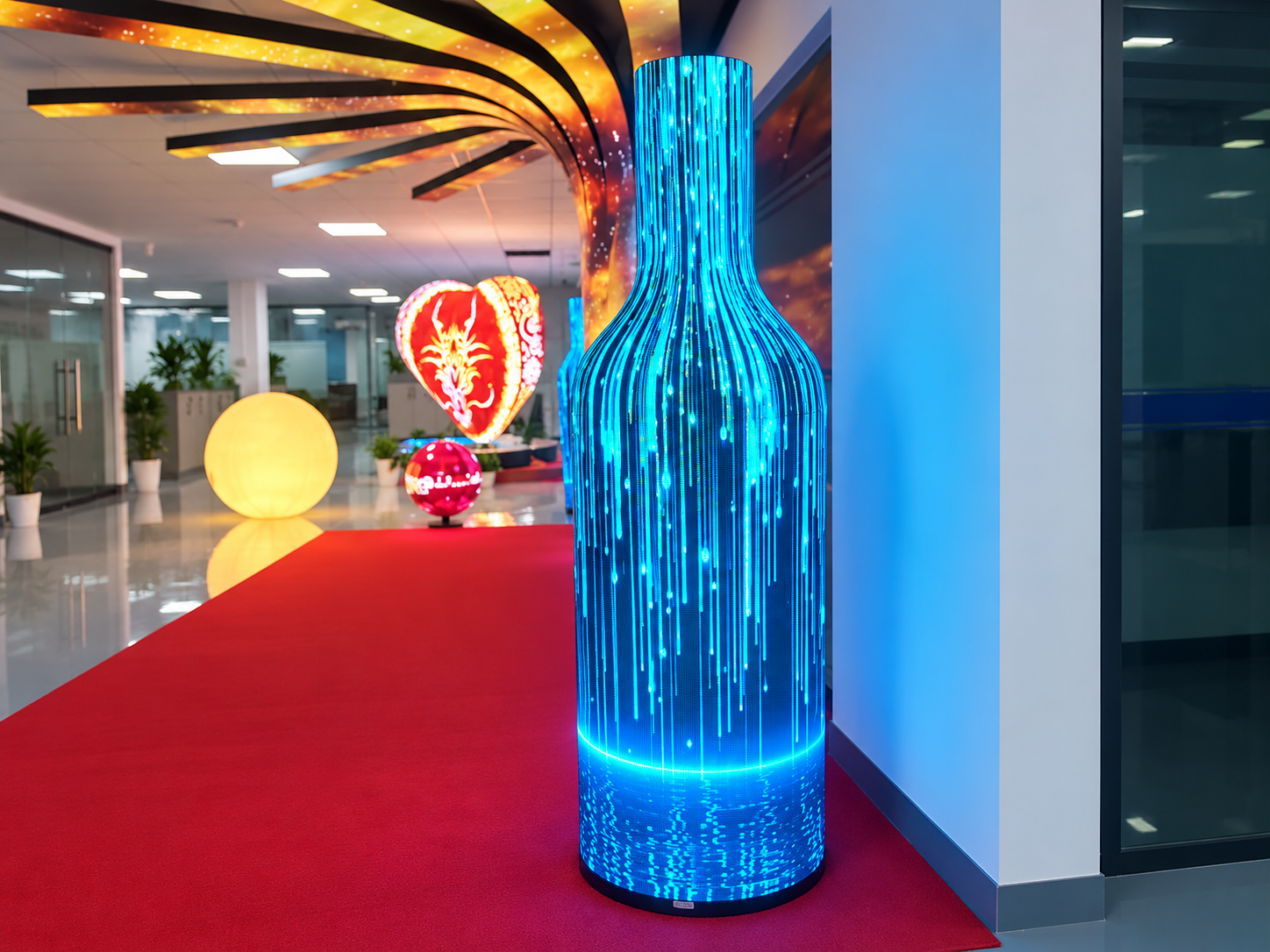
Metal trims, bottle caps, side frames, and other decorative parts may cover small sections of the LED surface. A logo that was centered before assembly may suddenly appear too close to an edge.
This is why the final content safe area must be checked after all decorative parts are installed, not only during the early design stage.
Unlike a rectangular LED screen, a bottle-shaped LED display has a narrow neck, curved shoulders, and a wider body. These different sections do not provide the same amount of usable display space.
When decorative parts are added, the visible area may become even smaller.
If this problem is ignored, several issues can appear:
Brand logos may be partly hidden by the frame.
Text may sit too close to the bottle shoulders.
Important graphics may become difficult to read from the side.
Animations may look incomplete around decorative edges.
These problems are especially noticeable in retail stores, beverage exhibitions, and promotional events where the bottle display is used to present a specific brand.
The screen may work normally, but the advertising message may not be displayed correctly.
The main cause is the difference between the LED module layout and the finished visible surface.
During production, the content designer usually works with a digital screen map. This map shows the available pixels, but it does not always reflect the final position of decorative components.
For example, a metal ring installed around the bottle shoulder may cover a narrow strip of pixels. A decorative base may hide part of the lower screen.
Even a small change in frame position can affect content placement.
Viewing angle also matters. A logo may look complete from the front but become partly hidden when customers approach from another direction.
Therefore, the final safe area should be based on the assembled product rather than the original design drawing alone.
The checking process can be divided into several practical steps.
All trims, caps, edge covers, and mounting parts should be installed before the final content check.
The screen should be positioned as it will be during normal use.
A simple test image with horizontal lines, vertical lines, and clearly marked borders helps identify which parts of the LED surface remain visible.
The technician checks whether any lines are covered by decorative components.
After checking the visible boundaries, a safe content area is defined.
Important information, including logos, product names, and promotional text, should remain within this area.
On most bottle-shaped designs, the wider body provides more suitable space for important content than the narrow neck.
A test grid alone is not enough.
The actual brand logo, product information, and animation should be displayed on the finished screen.
The content is then adjusted if letters, images, or important graphic elements appear too close to the decorative edges.
The display should be inspected from the front, both sides, and normal customer viewing distances.
This helps confirm that the main message remains visible during real use.
Once the content position has been adjusted, the display needs another complete check.
The team should examine static images, moving graphics, and different background colors.
Bright and dark test images are useful for finding areas where decorative parts create unwanted shadows or cover pixels.
The content should also be checked after restarting the display system to confirm that the correct mapping and content settings remain in place.
Final photographs or videos can be recorded as reference materials for installation and future content updates.
A bottle-shaped LED display normally requires flexible LED modules, a customized supporting frame, a control system, power supplies, and decorative finishing components.
The LED modules follow the bottle's curved surface, while the supporting structure maintains the required shape.
Decorative parts complete the appearance, but their dimensions and installation positions must be considered during screen design.
Choosing a suitable pixel pitch is also important, especially when the display will show small logos or text at close viewing distances.
Consider a bottle-shaped LED screen prepared for a beverage exhibition.
The display uses animated bottle graphics, a brand logo, and short promotional messages.
After the decorative bottle cap and shoulder trim are installed, the original logo position is found to be too high.
Instead of changing the finished structure, the content team moves the logo into the wider bottle body and uses the neck for simple color animation.
The brand message becomes easier to read without affecting the decorative design.
This example shows why final content checks should be included in the project workflow.
Can the safe area be confirmed before production?
An initial safe area can be planned, but final confirmation should take place after decorative assembly.
Does every bottle-shaped LED screen need a different safe area?
Yes. Bottle dimensions, module layout, decorative parts, and viewing angles can vary between projects.
Can the content be changed after installation?
Yes. Content can generally be updated through the LED control system, provided it follows the approved display mapping.
Shenzhen Ai Display Technology Co., Ltd. supplies customized LED display solutions, including wine bottle LED screens and other irregular-shaped displays.
Our team supports product design, structural planning, manufacturing, and technical guidance.
For bottle-shaped LED projects, careful coordination between the screen structure, decorative finishing, and content layout helps avoid unnecessary adjustments during final installation.
A successful bottle-shaped LED display should not only look like the intended product. It should also keep the brand message clear after every decorative component is in place.
For customized bottle-shaped LED display solutions, visit www.aileddisplay.com.
 Hot News
2026-10-21
2026-10-20
2026-10-19
Copyright © 2025 by Shenzhen Ai Display Technology Co., Ltd - Privacy policy
 EN