Installing a spherical LED screen is not simply a matter of hanging a ball from the ceiling or fixing it to a support.
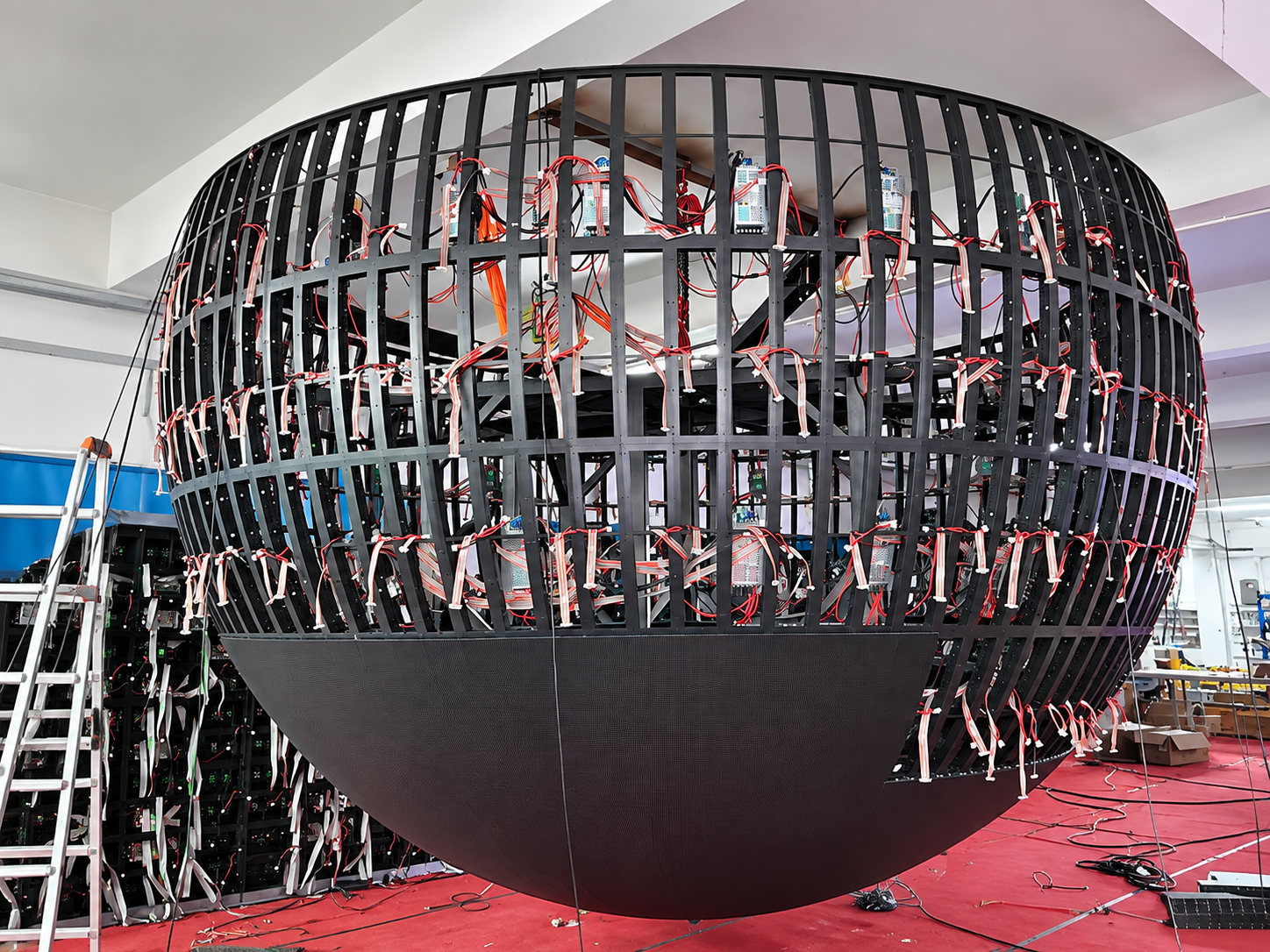
One small positioning error can affect the whole display.
The sphere may hang slightly off-center. The main content direction may face the wrong side of the room. The cable outlet may become visible. A maintenance opening may end up against a wall or ceiling structure.
For this reason, a good spherical LED screen installation should define several reference points before the screen is lifted into its final position.
A rectangular LED screen has obvious horizontal and vertical edges. Installers can use these edges to check whether the display is level.
A sphere does not have these reference lines.
After installation, even a small rotational change can move the intended “front” of the display to another viewing direction.
This becomes important when the screen shows:
Brand logos
Product names
Maps
Directional graphics
Text
Fixed-position animations
The mechanical installation and content mapping therefore need to use the same orientation reference.
Before lifting the LED sphere display, mark four positions on the structure:
Top pole
This is the main vertical reference for a hanging installation.
Bottom pole
The bottom point helps technicians confirm that the sphere remains vertically aligned after suspension.
Equator
The widest horizontal section of the sphere can be used as a visual leveling reference.
Front reference point
This position indicates the main viewing direction or the starting direction used for content mapping.
Do not wait until the sphere is hanging several meters above the floor to decide where the front should be.
Mark it during factory assembly.
A simple numbered or colored temporary label can prevent confusion during installation.
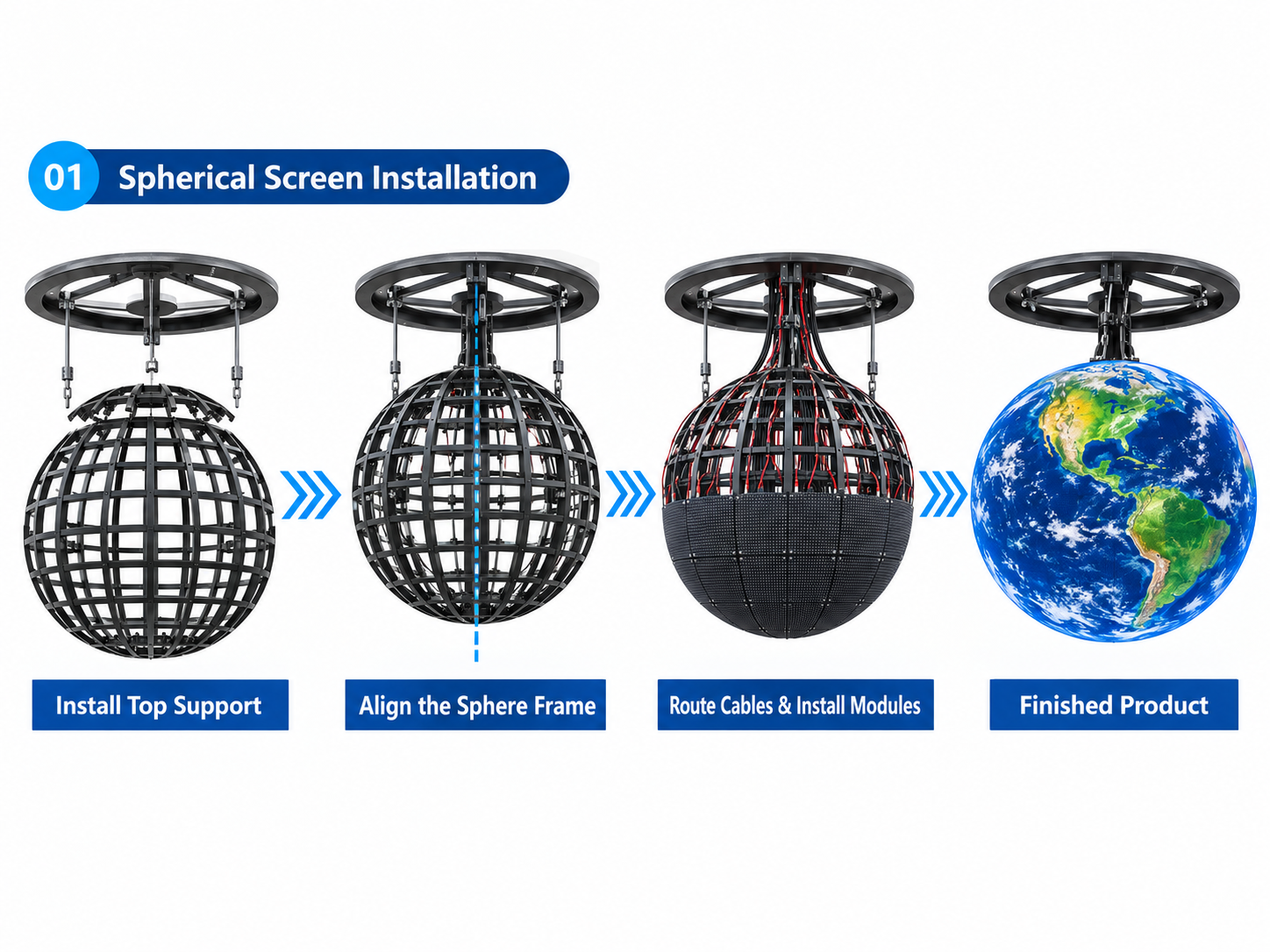
For a suspended spherical LED display, the lifting point should be aligned with the structural center of gravity as closely as possible.
If the suspension point is offset, the sphere may lean slightly after lifting.
This does not always look serious from directly below, but the problem becomes more visible when the display is viewed from a distance.
Before installation, check:
Sphere diameter
Total screen weight
Suspension structure
Building load point
Vertical centerline
Safety cable position
The ceiling connection should also be designed for the actual building structure rather than only for the weight of the LED modules.
For different diameters and installation requirements, our spherical LED display can be customized according to the project environment.
One common installation mistake happens after the screen has already been lifted.
The height is correct, but the sphere is rotated in the wrong direction.
This becomes a problem when the signal cable entry, maintenance area, receiving-card position, or content starting point has been designed for a specific side.
Before final tightening, establish a rotation reference.
For example:
0° = main entrance
Then mark 90°, 180°, and 270° around the sphere.
This simple reference system gives the installation team, content team, and control-system engineer the same coordinates.
It is especially useful in shopping malls, museums, showrooms, exhibition halls, and reception areas where people approach the screen from predictable directions.
Power and signal cables should not be treated as an afterthought.
A spherical structure has limited internal space, and cables must travel around curved frames rather than through a simple rectangular cabinet.
Before final assembly, confirm:
Power cable entry
Signal cable entry
Internal cable direction
Cable bending space
Separation between power and signal lines
Service access position
Spare cable route
For a hanging LED sphere, the cleanest solution is usually to route cables toward the upper suspension area where they can be integrated with the supporting structure.
Avoid allowing heavy cable bundles to pull sideways on the sphere.
A beautiful installation can become difficult to maintain if technicians cannot reach the internal components.
Before confirming the final position, ask:
If one receiving card, power supply, cable, or LED module fails, how will a technician reach it?
Leave enough access around the maintenance opening.
Do not position the service side directly against a beam, decorative ceiling panel, wall, lighting fixture, or other equipment.
This decision may save hours of work later.
For projects requiring different installation conditions, AILED also provides customized sphere globe LED screen solutions for indoor and outdoor applications.
Do not finish the installation immediately after the structure is fixed.
Run a final positioning test.
Display several test patterns:
Horizontal ring pattern:
Checks whether the visual equator appears level.
Vertical longitude lines:
Helps identify obvious rotational or mapping errors.
Numbered direction test:
Display 0°, 90°, 180°, and 270° to confirm physical orientation matches the control system.
Full white and full gray:
Check module consistency, seams, and abnormal areas.
Moving content:
Confirm that video crosses module boundaries smoothly.
Finally, walk around the sphere and inspect it from the main audience positions.
A correct test should evaluate the complete 360-degree display rather than only the side facing the technician.
Consider a 1.5-meter indoor spherical LED screen installed in the center of a museum exhibition area.
Visitors enter mainly from one side.
Before lifting, the installation team marks the entrance direction as 0°. The maintenance access area is rotated toward a less visible side, while power and signal cables leave through the top suspension structure.
After the sphere reaches its final height, a laser reference is used to check the vertical centerline.
The team then runs longitude and numbered-direction test content.
Only after the mechanical direction and content coordinates match is the suspension structure finally locked.
This process reduces the need to rotate or reopen the sphere later.
Factory pre-assembly is recommended before final installation so the structure, modules, control system, orientation, and cables can be checked first.
Sometimes, but it depends on the suspension structure and cable routing. It is better to confirm the direction before final fixing.
Yes. A physical reference point makes content positioning and troubleshooting much easier.
Yes. Depending on the project, a sphere can use hanging, floor-standing, or customized supporting structures.
AILED provides customized spherical LED screens, ball LED displays, globe LED screens, and other creative-shaped LED solutions.
We can support projects from structural design and pixel-pitch selection to control-system configuration, factory assembly, testing, packing, and installation guidance.
Before production, provide the installation location, required sphere diameter, viewing distance, mounting method, content requirements, and project environment.
This allows the mechanical structure, cable layout, service direction, and display specifications to be planned before the spherical LED screen reaches the installation site.
Copyright © 2025 by Shenzhen Ai Display Technology Co., Ltd - Privacy policy
 EN
EN
 Hot News