A mobile LED advertising display allows businesses to promote products, launch campaigns, and reach audiences in different locations. Unlike a fixed outdoor LED billboard, a vehicle-mounted screen depends on a power system that must work while the vehicle is moving or parked.

However, installing an LED screen is not simply a matter of connecting it to the vehicle battery.
The vehicle's electrical system must support the display, control equipment, and other connected devices. If the power supply is not properly designed, the screen may flicker, restart, or shut down during operation.
Before installation, vehicle operators should check the available power capacity, voltage compatibility, inverter performance, wiring, and electrical protection.
An unstable power supply can affect both the LED display and the vehicle.
For the display, insufficient power may cause unstable brightness, unexpected blackouts, or repeated system restarts. These problems are particularly noticeable when the screen plays bright advertising content.
For the vehicle, an overloaded electrical system may cause excessive alternator demand, battery discharge, or electrical component damage.
The problem can become more serious when the display operates for several hours while the vehicle is parked.
Therefore, power planning should be completed before the screen structure and installation position are finalized.
The first step is to understand how much electrical power the vehicle can provide.
Operators should check three important components:
Vehicle battery: The battery provides electrical energy for starting the engine and supporting electrical equipment. However, it should not be treated as an unlimited power source for a large LED display.
Alternator: When the engine runs, the alternator supplies electricity and charges the battery. Its available output must be sufficient for the vehicle's original electrical loads and the additional LED system.
Power inverter: Many mobile LED displays require AC input, while the vehicle battery provides DC power. An inverter converts DC electricity into the AC voltage required by the display system.
The inverter must match the display's input voltage, frequency, and total power demand.
For larger installations, a qualified automotive electrician should calculate the actual available capacity rather than relying only on the battery's rated capacity.
Before selecting an inverter, operators need to understand the LED screen's power consumption.
A basic calculation is:
Total Display Power = Screen Area × Maximum Power Consumption per Square Meter
For example, if a 6 m² outdoor LED display has a specified maximum power consumption of 600 W/m², its theoretical maximum power demand is:
6 × 600 W = 3,600 W.
This is an example only. Actual consumption depends on the screen model, brightness settings, content, and operating conditions.
The calculation should also include the video processor, media player, control system, and other electrical equipment.
Do not select an inverter based only on the screen's average power consumption. The system must also handle changes in electrical demand and the requirements of the connected equipment.
Even when the inverter has sufficient capacity, poor wiring can create power problems.
Long cables, undersized conductors, loose terminals, and unsuitable connectors can increase resistance and cause voltage drops.
This is especially important for mobile LED displays because vehicles experience vibration and repeated movement.
Before installation, check the following:
Cable size and rated current capacity.
Cable length and expected voltage drop.
Secure connections and suitable connectors.
Correctly rated fuses and circuit breakers.
Proper grounding and electrical isolation.
Protection against moisture, dust, and mechanical damage.
The power distribution box should also allow technicians to isolate individual circuits during maintenance.
All wiring, fuse selection, grounding, and high-current connections should be designed and inspected by qualified professionals.
A power system that works in a stationary workshop may not perform the same way on the road.
A practical commissioning test should cover several operating conditions.
Engine startup: Check whether the LED system remains stable when the vehicle starts. Confirm that the starting circuit and display power system do not interfere with each other.
Engine idling: Run the display at normal brightness while the vehicle is stationary. Monitor the electrical system for voltage drops and unstable operation.
High-brightness operation: Play bright or mostly white content to check whether the power system can handle higher electrical demand.
Driving conditions: Test the display under normal driving conditions and inspect cable connections, mounting points, and system stability.
Engine shutdown: Check how the display is powered after the engine stops. If it continues operating, verify the battery protection and automatic shutdown strategy to prevent excessive battery discharge.
Record the input voltage, inverter output, operating current, and any abnormal temperature changes during testing.
A reliable mobile LED advertising system usually includes several coordinated components:
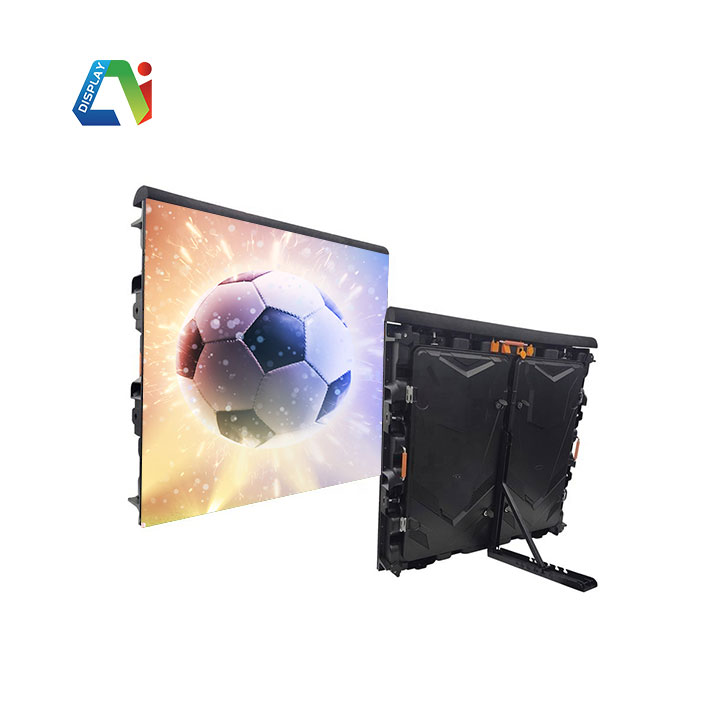
Outdoor LED display modules or cabinets.
DC-to-AC power inverter.
Power distribution cabinet.
Circuit protection devices.
Control system and video processor.
Waterproof power and signal connectors.
Ventilation and heat dissipation components.
The screen structure also needs to consider vehicle weight, installation space, wind resistance, and maintenance access.
For example, a truck-mounted LED screen may require a different structural and power arrangement from a smaller promotional van.
AiDisplay provides mobile LED screen solutions for vehicle-mounted and mobile advertising applications. Screen dimensions, pixel pitch, cabinet structure, and installation requirements can be considered according to the project.
Consider a company planning to install a large outdoor LED display on a promotional truck.
The vehicle will travel between shopping districts, exhibitions, and outdoor events. The screen needs to operate during both transportation and scheduled advertising periods.
Before installation, the project team should calculate the maximum screen load, check the alternator's available capacity, and select a suitable inverter.
The electrical system should also have independent protection for the LED display and vehicle circuits.
During commissioning, technicians can test the screen at different brightness levels, monitor voltage stability, and confirm the automatic shutdown function.
This approach helps reduce unexpected interruptions during advertising campaigns.
Q1: Can a mobile LED display connect directly to a vehicle battery?
Not necessarily. The display may require AC power or a specific DC input. A suitable power conversion and protection system should be designed before connection.
Q2: Can the LED display operate when the vehicle engine is off?
Yes, if the system has a properly designed independent battery or external power source. However, battery capacity and low-voltage protection must be considered.
Q3: How do I choose an inverter for a vehicle-mounted LED screen?
Check the display's maximum power demand, input voltage, frequency, and the additional load from control equipment. The inverter should have sufficient continuous capacity and suitable surge capability.
Q4: Why does a mobile LED screen restart when the vehicle is running?
Possible causes include unstable input voltage, insufficient inverter capacity, loose connections, excessive voltage drop, or electrical interference. A systematic inspection is necessary.
Q5: Does a mobile LED display need special maintenance?
Yes. Regularly inspect cables, connectors, electrical protection devices, ventilation, and mounting structures. Vehicle vibration and outdoor exposure make routine inspection particularly important.
A reliable mobile LED advertising display starts with proper power planning.
Before installation, vehicle operators should evaluate battery capacity, alternator output, inverter compatibility, wiring, and electrical protection. Testing under startup, idling, driving, and high-brightness conditions can reveal problems before the vehicle enters commercial operation.
AiDisplay focuses on customized LED display solutions for different advertising applications, including vehicle-mounted screens. By considering electrical requirements and installation conditions early, project teams can build a more stable and practical mobile advertising system.
 Hot News
2026-11-06
2026-11-05
2026-11-04
Copyright © 2025 by Shenzhen Ai Display Technology Co., Ltd - Privacy policy
 EN