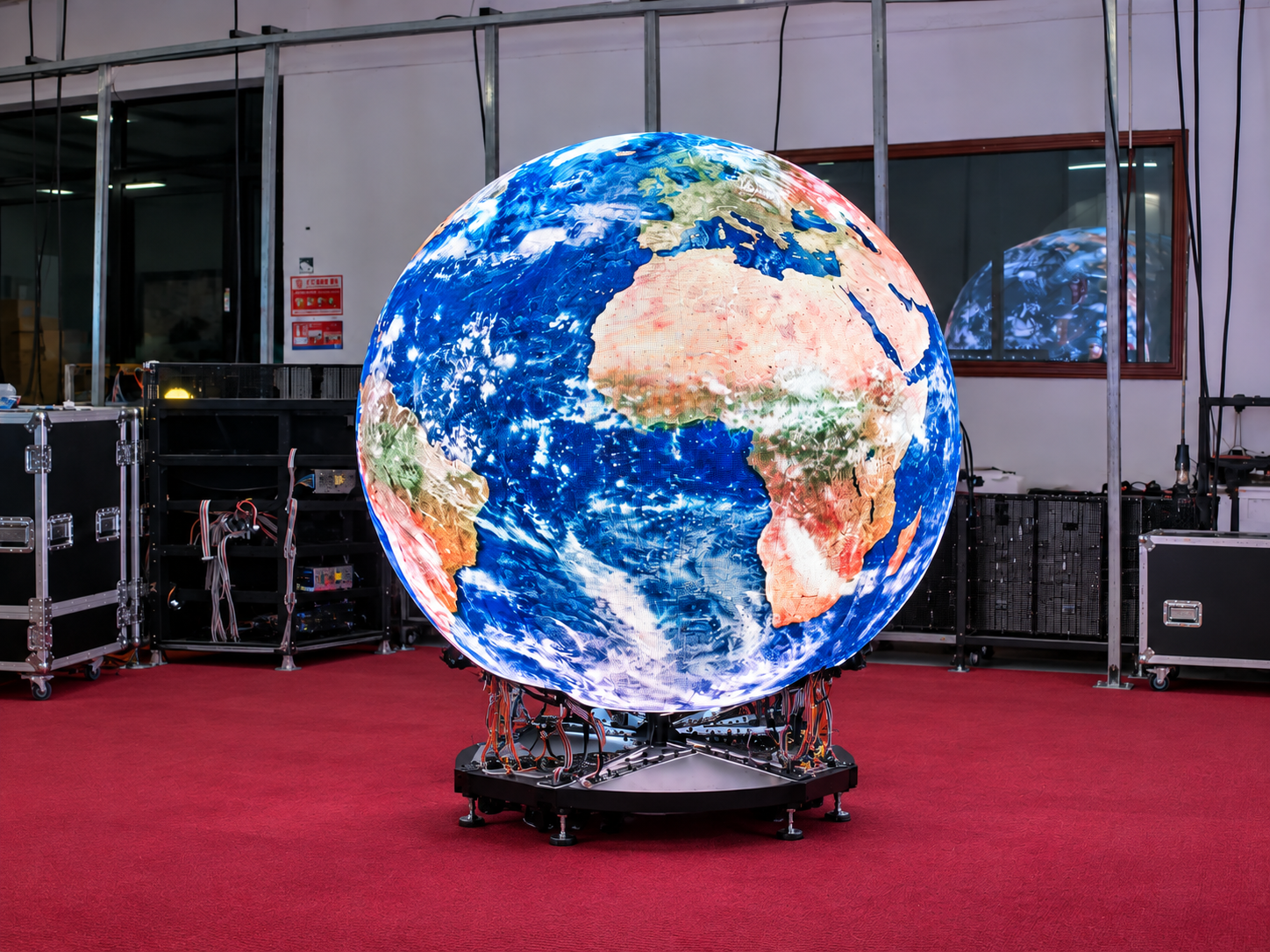
Museums use digital displays to explain history, present scientific ideas, and help visitors explore complex subjects. An LED ball display offers a different experience from a traditional flat screen. Its spherical shape allows content to be viewed from multiple directions, making it suitable for interactive and immersive exhibitions.
However, installing a spherical LED screen is not just about creating a visual attraction. The display must fit the exhibition space, work with the existing lighting, and present information clearly. If these factors are overlooked, even a high-quality screen may fail to support the visitor experience.
Ambient light has a direct effect on screen visibility. A display that looks clear in a bright showroom may appear too strong in a dark museum gallery. Excessive brightness can distract visitors from nearby artifacts, while insufficient brightness can make images and details difficult to see.
Content clarity is equally important. Visitors may approach the screen from different angles and distances. Small text, complicated graphics, and fast-moving images can become difficult to follow on a curved surface.
These problems can reduce viewing comfort and make it harder for visitors to understand the information being presented.
Three factors often create difficulties.
First, screen brightness may be selected according to maximum output rather than actual gallery conditions.
Second, the pixel pitch and sphere diameter may not match the expected viewing distance. Visitors standing close to the display need sufficient image detail.
Third, content designed for a flat screen may not work well on a spherical surface. Text and images can become distorted when mapped incorrectly, especially around curved areas.
Visitor dwell time also matters. Some people stop for only a few seconds, while others spend several minutes exploring an exhibit. Content should communicate its main message quickly while offering additional visual detail for those who stay longer.
Start by checking the ambient lighting throughout the exhibition area. Adjust the display brightness to suit the environment rather than automatically choosing the highest setting. Multiple brightness presets can help museums manage different lighting conditions.
Next, select the pixel pitch according to the closest expected viewing distance. A fine pixel pitch can improve detail for visitors standing near the screen, but the final choice should also consider the display size, content, and project budget.
Content should be designed specifically for the spherical format. Use clear shapes, readable labels, balanced colors, and smooth transitions. Keep important information away from areas where the image may appear distorted.
Finally, plan the display position carefully. The screen should attract attention without blocking exhibits, creating distracting reflections, or competing with printed information panels.
Testing under realistic conditions is essential.
Before final approval, display representative content at several brightness levels. Check readability from different viewing distances and angles, and compare the screen with the surrounding exhibition lighting.
It is also useful to test the complete content sequence. Observe whether visitors can understand the main message within a short viewing period and whether longer animations remain comfortable to watch.
For spherical displays, test image mapping, color consistency, module alignment, and video playback across the entire surface. These checks help identify problems before installation and reduce the need for adjustments on site.
A suitable LED ball display combines the right diameter, pixel pitch, control system, and mounting structure.
AILED offers spherical LED displays with various pixel pitches, including P1.2, P1.5, P1.8, P2, P2.5, and larger options. Screen diameters and installation arrangements can be customized according to project requirements.
Depending on the exhibition design, the display can be suspended from the ceiling or installed using a suitable support structure. The mounting solution should provide safe installation, stable operation, and practical access for maintenance.
For more information, visit the AILED Ball Sphere LED Display product page.
Spherical LED displays can support a wide range of museum and exhibition themes.
In a science museum, a digital globe can show planetary movement, weather systems, or global data. In a natural history exhibition, animated visuals can explain ecosystems and animal migration. In a history museum, a spherical display can present maps, trade routes, or changes in geographical boundaries.
AILED has also completed a 2-meter P2 suspended LED ball display project in Spain for a commercial indoor space. The project demonstrates how a spherical screen can create a visible focal point while keeping the floor area open. Similar structural concepts can be considered for suitable museum installations, subject to the project's lighting, safety, and content requirements.
See the Spain Indoor P2 LED Ball Screen Project for reference.
Q1: How bright should an LED ball display be in a museum?
There is no single ideal brightness level. It depends on ambient light, screen position, viewing distance, and nearby exhibits. Test the display under realistic gallery conditions before deciding.
Q2: Which pixel pitch is best for museum exhibits?
P1.8, P2, and other fine-pitch options may suit close-viewing indoor applications. The final choice depends on the sphere diameter, viewing distance, and content detail.
Q3: Can an LED ball display show text clearly?
Yes, provided the content uses suitable text sizes, sufficient contrast, and correct spherical mapping. Detailed information may still be better presented on separate labels or information panels.
A successful museum display requires more than a screen. It needs suitable product selection, reliable hardware, customized structural design, and careful testing.
AILED provides creative LED display solutions with customizable dimensions, pixel pitches, and installation options. Our team can help customers evaluate product specifications and plan a display around the needs of their projects.
If you are planning a museum exhibit or a science and technology exhibition, visit AILED's official website to explore spherical LED display solutions and discuss your project requirements.
The goal is simple: create a display that attracts visitors, communicates information clearly, and supports the exhibition rather than distracting from it.
 Hot News
2026-10-17
2026-10-12
2026-10-11
Copyright © 2025 by Shenzhen Ai Display Technology Co., Ltd - Privacy policy
 EN
EN