While the two displays share similar LED technology, their engineering requirements differ significantly.
|
Comparison Factor |
LED Hemisphere Screen |
|
|
Structure |
Complete sphere |
Half sphere |
|
Viewing Coverage |
360° viewing |
180° viewing |
|
Module Assembly Difficulty |
Very high |
Moderate |
|
Pixel Distribution |
Uniform across entire surface |
Concentrated on visible side |
|
Installation Complexity |
High |
Lower |
|
Brightness Requirement |
Typically ≥ 3500 nits |
Typically ≥ 2500 nits |
|
Space Requirement |
Larger |
More compact |
|
Relative Cost |
100% benchmark |
Approximately 55–70% of sphere cost |
A full sphere requires seamless LED module integration across the entire surface. Manufacturers must precisely adjust modules to match multiple curvature angles while maintaining extremely tight tolerances.
In contrast, a hemisphere screen only requires curved assembly on one side. Consequently, engineers can simplify the structure and reduce manufacturing complexity significantly.
Sphere screens distribute pixels evenly across the entire display surface. This design eliminates blind spots and ensures consistent image quality from every viewing angle.
However, hemisphere screens concentrate pixels only where audiences can see them. Therefore, they often achieve higher pixel utilization efficiency while reducing overall LED consumption.
Installing a sphere screen typically involves suspended mounting systems or custom support structures. Since the display remains visible from all directions, engineers must carefully consider load-bearing capacity and structural stability.
Meanwhile, hemisphere screens offer greater installation flexibility. You can mount them on walls, integrate them into architectural surfaces, or place them directly on the floor. This flexibility often shortens installation time and lowers project costs.
A sphere screen must maintain visibility from every angle while handling changing ambient light conditions. Therefore, higher brightness levels often become necessary.
A hemisphere screen focuses on a single viewing direction. As a result, operators can often achieve excellent visual performance with lower brightness levels.
For the same diameter, a hemisphere screen uses significantly fewer LED modules and requires a simpler support structure.
Consequently, hemisphere displays typically cost 30–45% less than comparable full sphere installations.
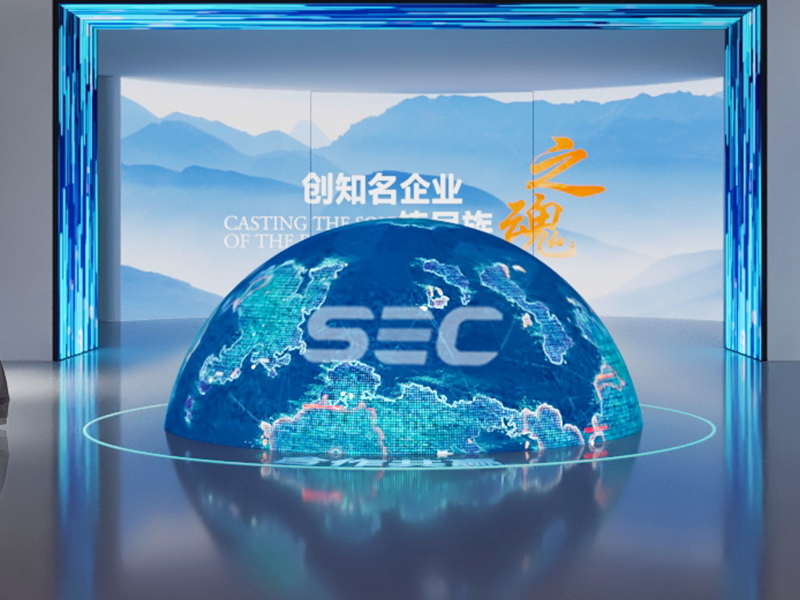
The real distinction lies in how each display interacts with its environment and audience.
Choose a sphere screen when you want to attract attention from all directions and create a memorable visual landmark.
Sphere screens draw visitors from every entrance and increase overall exposure for advertisements and promotional content.
Museums frequently use sphere displays to visualize planets, galaxies, weather systems, and scientific data in a highly engaging format.
Cities and attractions often install giant sphere screens as iconic photo destinations that encourage social media sharing.
Exhibitors use sphere displays to showcase products in a way that visitors can explore from every angle.
Choose a hemisphere screen when audiences approach from one primary direction and when efficient use of space is important.
Hemisphere displays create eye-catching visual experiences while fitting naturally into architectural structures.
Cinemas, cultural attractions, and themed experiences often use dome-shaped displays to surround viewers with content.
Companies use hemisphere screens to highlight key presentations, product launches, and brand stories without occupying central floor space.
Curators can integrate hemisphere displays directly into exhibit walls, allowing digital content to complement physical artifacts.
If your goal is to maximize visibility from every direction and create a landmark attraction, an LED sphere screen delivers the strongest visual impact.
However, if you want a more cost-effective solution, need to save space, or expect viewers to watch from a single direction, an LED hemisphere screen often provides the better return on investment.
In short, sphere screens excel at 360-degree audience attraction, while hemisphere screens excel at focused, immersive storytelling. The best choice depends on your venue layout, audience flow, installation conditions, and budget.
 Hot News
2026-09-17
2026-09-16
2026-09-15
Copyright © 2025 by Shenzhen Ai Display Technology Co., Ltd - Privacy policy
 EN
EN