Staircases and landings are common in shopping malls, hotels, office buildings, exhibition halls, and commercial spaces. These areas offer good opportunities for digital advertising and architectural displays. However, they also create a special challenge: viewers do not stay at the same height.
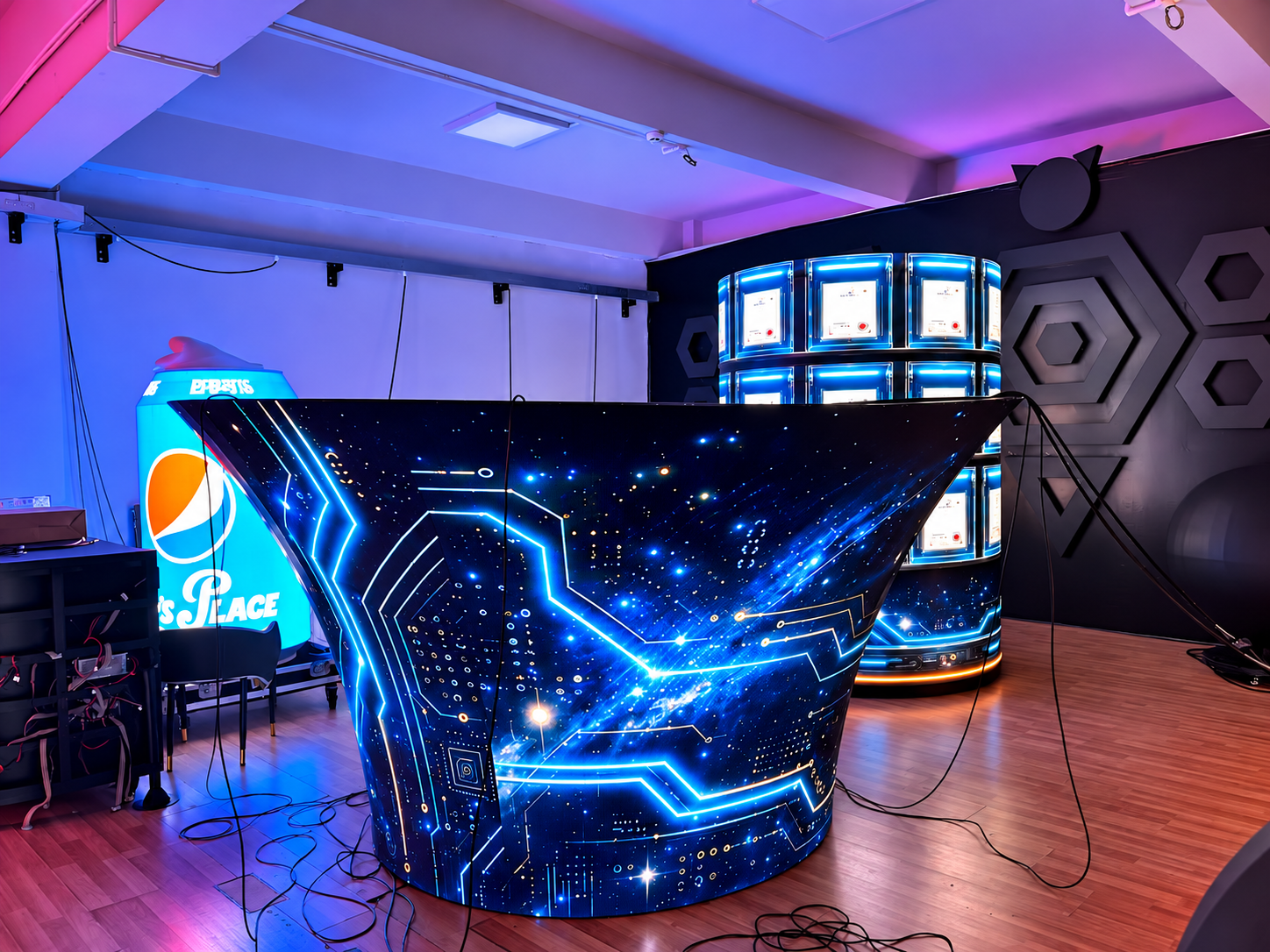
A person at the bottom of a staircase looks upward. Someone halfway up sees the display from a different angle, while a person standing on the upper landing may look downward. If an LED display is designed for only one viewing position, parts of the content may become difficult to see.
The goal is not simply to install a large screen. It is to make the display work for people moving through the space.
A screen that ignores changing viewing heights can create several problems. Text may become difficult to read, images may look distorted, and important information may disappear from certain viewing positions.
The problem becomes more noticeable when the display follows a staircase wall or wraps around a curved landing. Different parts of the screen may face viewers at different angles.
Brightness also matters. A screen that looks comfortable from one position may appear too bright or uncomfortable from another. In busy public spaces, poor positioning can also compete with directional signs and the visual attention needed for safe movement.
These issues can reduce the value of the installation, even when the LED screen itself has good image quality.
Before selecting LED modules, study how people move through the staircase.
Identify the main viewing positions: the bottom step, the middle section, the upper landing, and nearby walking routes. Measure the approximate eye heights, viewing distances, and angles from these positions.
Do not design around only the center of the display. The top and bottom edges may be viewed from very different angles, especially on tall staircases.
Also consider the content. Large images, logos, and short messages are easier to understand at a glance than small text or detailed graphics. Place the most important information within the viewing area shared by most visitors.
Flexible LED displays can follow curved walls, rounded corners, and irregular architectural surfaces. They give designers more freedom than a conventional flat screen when the staircase or landing has a curved layout.
However, flexibility alone does not solve every viewing problem. The screen shape, mounting angle, installation height, and curvature must work together.
For a long staircase wall, a display may follow the slope of the stairs to create a continuous visual effect. For a curved landing, flexible modules may follow the wall around a corner, helping the screen fit naturally into the architecture.
Avoid adding unnecessary curves just to create a striking appearance. The shape should support viewing comfort, content clarity, and the building's design.
A practical testing process can prevent costly adjustments after installation.
First, prepare a layout showing the screen dimensions, mounting position, viewing distances, and expected angles. Use a 3D model or a full-size visual reference to check how the display appears from different points.
Next, test the actual content rather than relying only on attractive promotional videos. Include text, logos, faces, and moving images.
Check the display from the bottom of the stairs, halfway up, at the upper landing, and from both sides where possible. Look for distorted content, uncomfortable viewing angles, excessive brightness, and areas that are blocked by railings or other structures.
Finally, verify structural stability, cable routing, power access, ventilation, and maintenance space. If the design does not work well from the main viewing positions, adjust the screen layout before production.
A successful staircase LED project requires more than flexible modules. The supporting frame must match the building structure and hold the display securely at the planned angle.
Important factors include pixel pitch, module dimensions, connection methods, mounting brackets, power supplies, receiving cards, and signal cables. Pixel pitch should be selected according to viewing distance and the level of detail required.
Maintenance also needs attention. Staircases and landings may have limited working space, so technicians should be able to access key components without unnecessary dismantling.
A well-planned structure keeps the installation neat, reduces maintenance difficulties, and helps the display remain reliable over time.
Consider a shopping mall installing a flexible LED display along a staircase wall connecting two retail floors.
Instead of choosing the screen size first, the project team studies the main walking routes and viewing angles. The display follows the wall's slope, while key promotional messages remain large and easy to read.
At the lower and upper landings, the team checks whether the screen competes with directional signs or draws too much attention from people moving through the area. Brightness and content transitions are adjusted to suit the indoor environment.
Before installation, the complete layout is reviewed for image clarity, structural fit, cable access, and maintenance space.
This approach allows the display to become part of the building's visual design without ignoring the practical needs of visitors.
Can flexible LED displays follow a staircase wall?
Yes. Flexible LED dispaly can be used on suitable curved or irregular surfaces. The final design depends on the required shape, mounting structure, and module specifications.
How can the display remain clear at different heights?
Plan around several viewing positions instead of one fixed eye level. Check screen angles, content placement, viewing distance, and brightness before installation.
Should the entire display follow the staircase slope?
Not always. A sloped layout may suit a long staircase, while a landing may require a different orientation. The best arrangement depends on the architecture and audience movement.
What should be checked before production?
Confirm dimensions, viewing angles, pixel pitch, structural support, power and signal routing, content layout, and maintenance access.
Shenzhen Ai Display Technology Co., Ltd. provides LED display solutions, including indoor, outdoor, and irregular-shaped LED displays. Its product range includes cylindrical, spherical, and custom-shaped display options for different commercial and architectural applications.
For staircase and landing projects, the design should begin with the actual installation environment. Screen shape, module selection, mounting structure, viewing angles, and maintenance requirements all need to be considered together.
By planning these details before production, businesses can create flexible LED displays that fit the architecture and remain comfortable to view as people move between floors.
Visit AILED to explore LED display solutions for your next custom installation.
 Hot News
2026-10-19
2026-10-17
2026-10-12
Copyright © 2025 by Shenzhen Ai Display Technology Co., Ltd - Privacy policy
 EN