Traditional rectangular LED displays have become a common sight in shopping malls, stadiums, and commercial buildings. As businesses seek more eye-catching digital solutions, spherical LED displays have emerged as one of the most innovative options on the market.
Thanks to their three-dimensional design and 360-degree viewing angle, LED spheres create immersive visual experiences that conventional flat screens simply cannot match. However, manufacturing a spherical display requires specialized assembly techniques that differ significantly from those used for standard LED cabinets.
This article explores the primary structural installation technologies used to build spherical LED displays and explains how each method contributes to performance, durability, and appearance.
Riveting is one of the most widely used assembly methods for spherical LED displays.
Riveting is a one-sided fastening process that joins multiple components together using blind rivets. During installation, technicians insert a rivet into a pre-drilled hole and use a rivet gun to pull the mandrel. As the mandrel retracts, the rivet expands on the opposite side, permanently clamping the materials together before the mandrel snaps off.
Because installers only need access from one side, riveting is particularly suitable for enclosed structures such as spherical LED screens.
A spherical display consists of numerous triangular, polygonal, or specially shaped modules that must align precisely to form a smooth surface. Riveting allows technicians to position and secure these components accurately, helping maintain a uniform curvature and seamless appearance.
Suspended or freestanding spheres experience varying mechanical stresses during operation and transportation. Riveted joints create permanent mechanical connections that resist loosening caused by vibration, thermal expansion, or contraction. As a result, they often provide greater long-term stability than conventional screw fasteners.
The interior of a spherical LED display offers limited working room. Since riveting requires access from only one side, installers can secure external modules without reaching behind the structure, making assembly significantly more practical.
When properly installed, blind rivets create tight fastening points that help reduce water penetration around mounting holes. Combined with sealing materials, this approach enhances environmental protection for outdoor spherical LED displays.
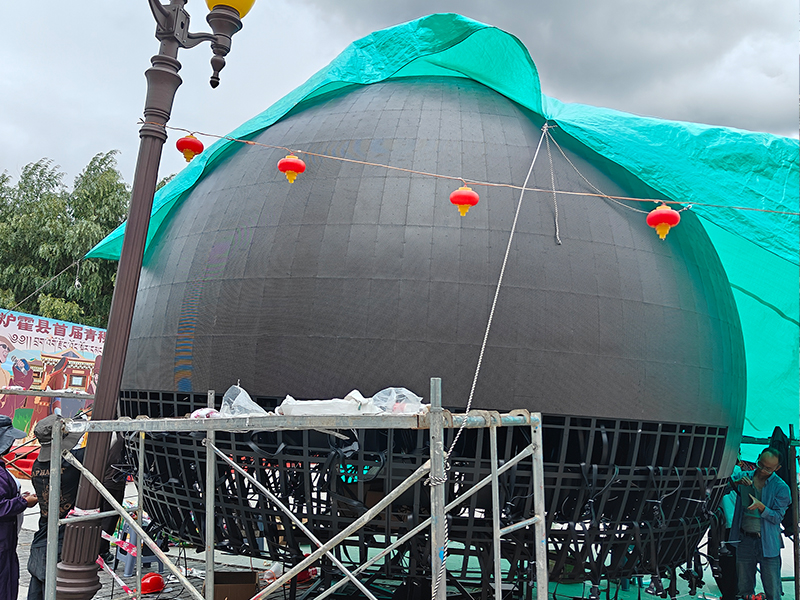
While riveting secures many external components, the internal load-bearing framework relies on separate structural connection methods.
Engineers typically fabricate the main frame from aluminum profiles or steel members and connect these structural elements using high-strength bolts or other heavy-duty mechanical fasteners.
This approach is particularly effective for:
However, structural bolted connections do not replace riveting for attaching exterior LED modules or surface panels, especially where only one-sided access is available.
Several complementary technologies further improve the quality and reliability of spherical LED displays.
In areas with tight curvature, manufacturers may use flexible LED modules instead of rigid panels.
The flexible PCB bends slightly to conform to curved surfaces, while adhesive backing or hook-and-loop fasteners secure the module to the supporting structure. Flexible ribbon cables then carry signals between modules, allowing the display to maintain a smooth spherical profile.
Complex intersections inside the sphere may benefit from customized connection nodes produced through metal additive manufacturing or high-strength nylon 3D printing.
These specialized components can:
Engineers typically integrate these custom nodes with bolts or rivets to complete the assembly.
Although sealing does not directly join structural components, it plays a critical role in protecting outdoor LED spheres.
Common waterproof measures include:
Together, these techniques help improve weather resistance and extend the display's operational life.
Constructing a spherical LED display requires far more than simply bending conventional LED panels into a round shape. Manufacturers combine precision riveting, robust structural frameworks, flexible modules, advanced fabrication techniques, and comprehensive waterproofing systems to achieve a durable and visually seamless result.
Among these technologies, riveting remains one of the most important assembly methods because it provides reliable one-sided fastening, excellent structural stability, and precise alignment for complex curved surfaces. When integrated with a well-engineered internal frame and high-quality sealing solutions, it enables spherical LED displays to deliver outstanding performance in both indoor and outdoor applications.
 Hot News
Copyright © 2025 by Shenzhen Ai Display Technology Co., Ltd - Privacy policy
 EN
EN