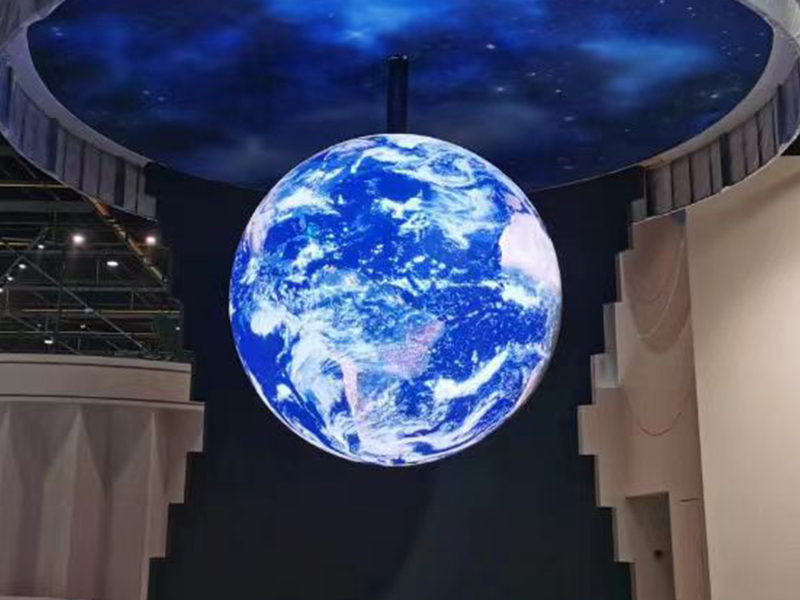
In recent years, sphere LED displays have become one of the fastest-growing segments in the creative display industry. As brands increasingly seek immersive and memorable visual experiences, traditional flat screens often struggle to deliver the same level of engagement and innovation.
According to industry research, the global sphere LED display market reached approximately USD 527 million in 2024 and is expected to approach USD 820 million by 2031, growing at a CAGR of 6.4% between 2025 and 2031. Meanwhile, the spherical and hemispherical display segment generated approximately USD 43 million in 2024 and is projected to reach USD 75 million by 2031.
More importantly, market studies indicate that the global spherical display market has maintained a compound annual growth rate exceeding 18% over the past five years, significantly outperforming traditional display technologies.
The growing popularity of sphere LED screens is easy to understand. Research shows that 3D digital advertising attracts viewing rates as high as 85%, with eight out of ten viewers expressing interest in the content. In comparison, conventional flat advertising typically achieves viewing rates of only 40% to 50%.
In addition, creative display formats such as spherical and curved LED screens generate more than three times the advertising recall rate of traditional rectangular displays while improving brand recognition by up to 40%.
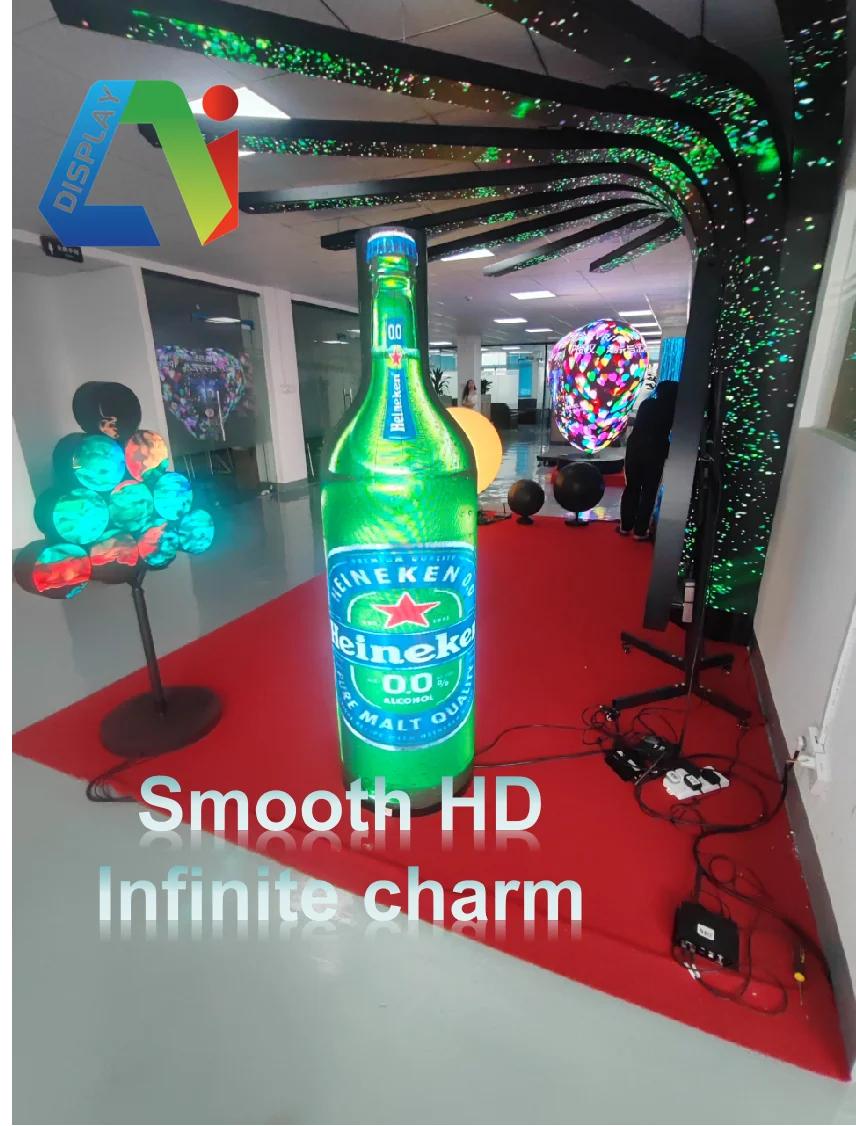
For brands seeking innovation, a sphere LED display offers much more than a screen—it creates a futuristic visual centerpiece that combines digital content, lighting, sound, and spatial design to deliver truly immersive experiences.
The visual performance of a sphere LED display depends heavily on selecting the appropriate technical specifications.
Pixel Pitch
Pixel pitch determines image clarity and should always match the intended viewing distance.
Generally:
Many commercial projects choose P2.5 because it delivers excellent visual performance without significantly increasing investment costs. However, the ideal specification ultimately depends on the installation environment, sphere size, and viewing distance.
Brightness
Brightness affects screen visibility under different lighting conditions.
Typical recommendations include:
Selecting the appropriate brightness level ensures optimal image visibility while avoiding unnecessary power consumption.
Refresh Rate
Refresh rate refers to the number of times the screen updates its image every second.
A higher refresh rate delivers:
This becomes particularly important for exhibitions, live events, and virtual production environments.
Grayscale Performance
Grayscale determines how accurately a display reproduces subtle brightness variations and color transitions.
Higher grayscale levels provide:
Thermal management represents one of the biggest engineering challenges for spherical displays.
Unlike conventional flat screens, a sphere creates an enclosed structure where heat can accumulate more easily. At the same time, traditional cooling methods may compromise the aesthetic appearance of the installation.
Most high-quality sphere LED displays use aluminum-based PCBs instead of conventional fiberglass boards.
The superior thermal conductivity of aluminum quickly transfers heat away from LED chips, helping maintain stable operating temperatures and extending component lifespan.
Larger sphere displays typically operate at higher brightness levels and generate more heat.
To address this challenge, manufacturers often install:
These solutions continuously remove hot air and improve internal airflow.
Smaller sphere LED displays often rely on passive cooling methods.
Engineers design internal support structures with open-frame or lattice configurations to minimize airflow resistance. This allows warm air to rise naturally while cooler air enters from below, creating efficient circulation without mechanical assistance.
Outdoor sphere LED displays require additional consideration because they must manage both heat and environmental exposure.
Manufacturers typically combine:
These measures protect the display from both solar heat gain and water intrusion.
Without proper thermal management, excessive heat can accelerate LED degradation, age encapsulation materials, increase dead-pixel rates, and reduce overall system reliability.
Building a perfect sphere requires far more than bending conventional LED panels.
Standard rectangular LED modules cannot form a smooth spherical surface. Instead, manufacturers create the display using specially engineered geometric modules, including:
These customized modules fit together like a three-dimensional puzzle to form a complete sphere.
Advanced manufacturers such as AI Display utilize riveted structural systems that create smoother surfaces and improved curvature consistency. This approach minimizes visible gaps and enhances overall visual quality.
The result is a highly uniform spherical display capable of delivering seamless 360-degree content presentation.
One of the most common questions about sphere LED displays is how they avoid image distortion.
If you simply play a standard 16:9 video on a sphere, the content becomes severely stretched and compressed. Objects near the poles appear distorted, while content around the equator appears elongated.
To solve this challenge, sphere LED displays rely on advanced 3D mapping technology.
Engineers first create a digital 3D model of the sphere.
The video content then wraps around the virtual sphere like a skin covering a globe. Mapping software calculates the precise position of every pixel, ensuring that images maintain their correct proportions when displayed on the curved surface.
Most professional sphere LED installations use advanced video processors from manufacturers such as NovaStar and Brompton.
These systems support customized module layouts through dedicated configuration files. Instead of treating the display as a flat rectangle, the processor recognizes the screen as a spherical structure.
The system then applies pre-distortion corrections to the source content, effectively canceling out the geometric distortions introduced by the sphere.
For the best results, designers often create content specifically for spherical displays.
During production, they use sphere UV mapping templates to visualize how graphics will appear once wrapped around the display surface.
This workflow ensures that content such as:
appears natural and visually accurate without stretching or deformation.
Sphere LED displays combine innovative engineering with exceptional visual impact. Their ability to present seamless 360-degree content makes them an ideal solution for shopping malls, museums, science centers, exhibitions, corporate lobbies, entertainment venues, and public art installations.
As immersive marketing continues to evolve, brands increasingly rely on sphere LED displays to create memorable experiences that attract attention, increase engagement, and strengthen brand recognition.
With advances in LED technology, thermal management, content mapping, and custom module manufacturing, sphere LED displays are becoming one of the most powerful tools for next-generation digital storytelling.
 Hot News
2026-10-21
2026-10-20
2026-10-19
Copyright © 2025 by Shenzhen Ai Display Technology Co., Ltd - Privacy policy
 EN
EN