Purchasing a circular LED display requires more than just comparing prices. To ensure you get a high-quality, reliable, and visually stunning screen, you need to focus on technical specifications, soft module quality, and the capabilities of the asymmetric LED screen manufacturer. Here are the top five questions every buyer should ask.
1. What is the Refresh Rate?
Why it matters:
- A high refresh rate ensures flicker-free video playback, especially important for photography, live streaming, and broadcast environments.
- For indoor circular screens, look for ≥ 3840 Hz. Lower refresh rates can cause flickering in camera shots, impacting promotional content and live events.
Tip: Ask the manufacturer to demonstrate the screen on camera to check for flicker.
2. Does It Support Asynchronous Control?
Why it matters:
-
Asynchronous control allows the screen to operate independently from a PC or server.
- This is essential for real-time content updates, multi-screen synchronization, and stable playback even if the main system is offline.
- Without it, any network lag or computer crash could pause your display, especially problematic in retail or exhibition settings.
Tip: Confirm the software supports both synchronous and asynchronous playback.
3. How Are the Seams and Module Gaps Handled?
Why it matters:
- Circular or irregular-shaped screens require precise module alignment.
- Poor seam handling leads to visible gaps, uneven brightness, and distorted images.
- Check if the manufacturer uses soft modules with minimal tolerance and adjustable mounting brackets to achieve a seamless effect.
Tip: Ask for close-up photos or video of a fully assembled screen to verify edge quality.
4. What is the Quality of the Flexible Modules?
Why it matters:
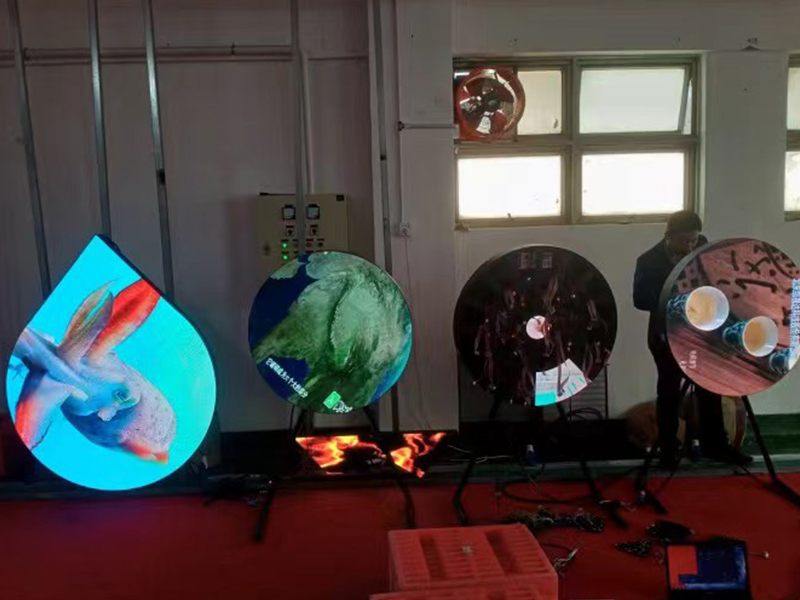
- The soft module (flexible LED module) determines how easily you can shape the screen into curves, waves, or spheres.
- Low-quality modules can cause pixel failure, color inconsistency, or uneven brightness over time.
- Reliable modules should use high-quality LEDs, durable PCB material, and precise SMD alignment.
Tip: Request manufacturer specifications and test reports on module lifespan and brightness uniformity.
5. What Are the Power, Heat, and Structural Considerations?
Why it matters:
- Circular screens often have irregular forms, which can limit airflow and heat dissipation.
- Confirm the manufacturer has adequate thermal design, power efficiency, and a stable mounting system to prevent deformation or premature failure.
- Poor structural design can lead to maintenance issues and higher long-term costs.
Tip: Ask about built-in cooling mechanisms, heat-resistant materials, and maintenance accessibility.
Bonus Advice for Buyers
-
Compare multiple asymmetric LED screen manufacturers to assess craftsmanship, delivery timelines, and after-sales support.
- Ensure the software ecosystem is user-friendly for content updates and creative displays.
- Consider future scalability—can you expand the display or integrate multiple screens without redesigning the modules?
Conclusion
By asking these five critical technical questions, you can avoid common pitfalls when investing in a circular LED display:
- Refresh rate ≥ 3840 Hz
- Supports asynchronous control
- Seamless module alignment
- High-quality flexible modules
- Proper thermal, power, and structural design
This approach ensures that your investment delivers long-lasting performance, visual excellence, and reliability, making your LED screen procurement both efficient and worry-free.
 Hot News
 EN
EN