For an event production company, buying LED screens is a long-term investment. The equipment may be used for concerts this month, a trade show next month, and corporate events throughout the year.
A good rental LED screen needs to deliver clear images, but it also needs to be easy to transport, install, remove, and maintain. These practical details can make a big difference when your team works under tight event schedules.
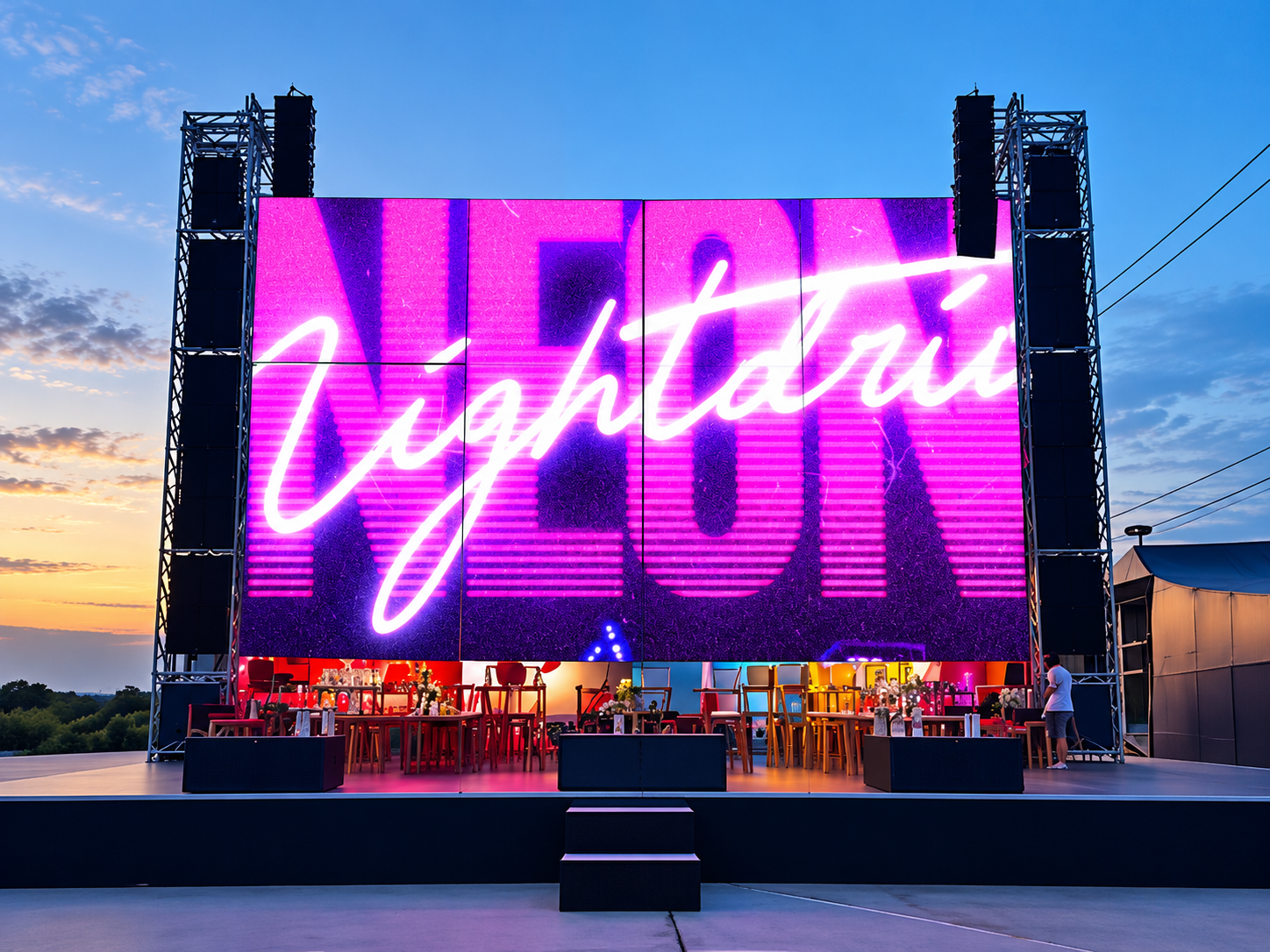
Before placing an order, here are the main things to consider.
Not every event needs the same type of LED display.
Indoor conferences often use screens for presentations, videos, and live camera feeds. Outdoor concerts may need brighter displays that can handle changing weather conditions.
Think about the projects your company handles most often.
For example, if you mainly organize indoor conferences, you may prefer a finer pixel pitch for shorter viewing distances. If your business focuses on outdoor festivals, weather protection and brightness will be more important.
It is also worth considering whether your screens will be used as flat video walls, stage backgrounds, or displays built into different stage designs.
Choosing equipment based on your regular projects can help you avoid buying features you rarely need.
Pixel pitch is the distance between the centers of two neighboring LED pixels. It affects how detailed the image appears at different viewing distances.
A smaller pixel pitch provides higher pixel density, which can be useful when people stand close to the screen.
Common rental LED display options include P1.95, P2.6, P2.97, P3.91, and P4.81.
For example:
P1.95 or P2.6: Worth considering for indoor events where viewers are relatively close.
P2.97: A possible option for conferences, exhibitions, and general indoor event use.
P3.91 or P4.81: Common choices for larger screens where the audience is farther away.
These are general examples rather than fixed rules. The final choice should depend on screen size, viewing distance, content, and project budget.
Always ask the supplier for the actual specifications of the model you plan to buy.
Rental LED screens are assembled from individual cabinets.
Two common cabinet sizes are 500 × 500 mm and 500 × 1000 mm. Both can be useful, depending on the type of events you handle.
Smaller cabinets can offer more flexibility when building screens with different dimensions. Larger cabinets may reduce the number of units needed for some installations.
However, cabinet size is not the only consideration.
Check the cabinet weight, locking system, alignment accuracy, handles, and protection around the LED modules.
A well-designed cabinet should be practical for technicians who assemble and remove screens regularly.
Also confirm whether different cabinet sizes can be combined within the same product series. Do not assume that all rental LED cabinets are interchangeable.
Event production teams often have limited time to prepare a venue.
A rental display that is difficult to assemble can slow down the entire installation process.
Before buying, ask how the cabinets connect and whether the screen supports hanging, ground stacking, or both.
You should also check the maintenance method.
Some rental LED displays allow technicians to replace modules from the front. Others require rear access. The suitable design depends on the product and installation conditions.
For outdoor events, ask about weather protection and operating temperature limits.
If the screen will be suspended, make sure the mounting hardware and supporting structure meet the requirements of the venue and are reviewed by qualified personnel.
A clear installation manual is just as important as the hardware itself.
Many concerts and corporate events use professional cameras to show performers or speakers on large screens.
This makes refresh rate and camera compatibility important.
A high refresh rate can help reduce visible scanning lines and flicker when the screen is filmed. However, camera shutter settings, LED driving methods, and the video processing system also affect the final result.
Ask the manufacturer for real camera test footage if your company frequently handles live broadcasts or recorded events.
You should also check brightness adjustment, color consistency, and grayscale performance.
A screen that looks good to the audience should also work well with the cameras and video equipment used at your events.
Rental LED equipment is moved frequently.
Cabinets may travel between venues, be loaded into trucks, and go through repeated assembly cycles.
For this reason, transportation protection should be considered before purchasing.
Ask whether suitable flight cases are available and how many cabinets each case can hold.
You should also discuss spare LED modules, power supplies, receiving cards, and cables.
Keeping commonly used spare parts can help your technicians deal with unexpected issues during an event.
If you plan to expand your LED inventory later, ask whether future orders will remain compatible with your existing cabinets and control equipment.
The lowest purchase price does not always mean the lowest operating cost.
When comparing quotations, consider the complete package.
This may include:
LED cabinets and control equipment
Hanging or stacking accessories
Flight cases and spare parts
Transportation and import costs
Warranty conditions and technical support
Ask for a detailed quotation that clearly identifies what is included.
It is also useful to discuss module replacement, maintenance access, and the availability of compatible parts.
These details can affect how much time and money your company spends maintaining the equipment over several years.
A clear project brief makes it easier for a manufacturer to recommend suitable products.
Before requesting a quotation, prepare the following information:
| Item | What to Confirm |
|---|---|
| Main application | Concerts, conferences, exhibitions, or mixed events |
| Environment | Indoor, outdoor, or both |
| Typical screen size | Width and height |
| Viewing distance | Approximate audience distance |
| Installation | Hanging, ground stacking, or both |
| Quantity | Number of cabinets or total display area |
| Delivery location | Country and destination |
You can review the available Rental LED Screen products from AILEDDISPLAY to compare different models and cabinet configurations.
Choosing rental LED screens is about more than image resolution.
For an event production company, cabinet design, installation speed, maintenance, transport protection, and long-term compatibility all affect how practical the equipment will be.
Start with the types of events you handle, compare the actual product specifications, and ask clear questions before ordering.
If you are planning to purchase rental LED screens, contact AILEDDISPLAY with your preferred screen size, application, quantity, and delivery location to discuss suitable product options.
 Hot News
Copyright © 2025 by Shenzhen Ai Display Technology Co., Ltd - Privacy policy
 EN