
A COB LED display can look excellent in a specification sheet but still show visible differences after installation.
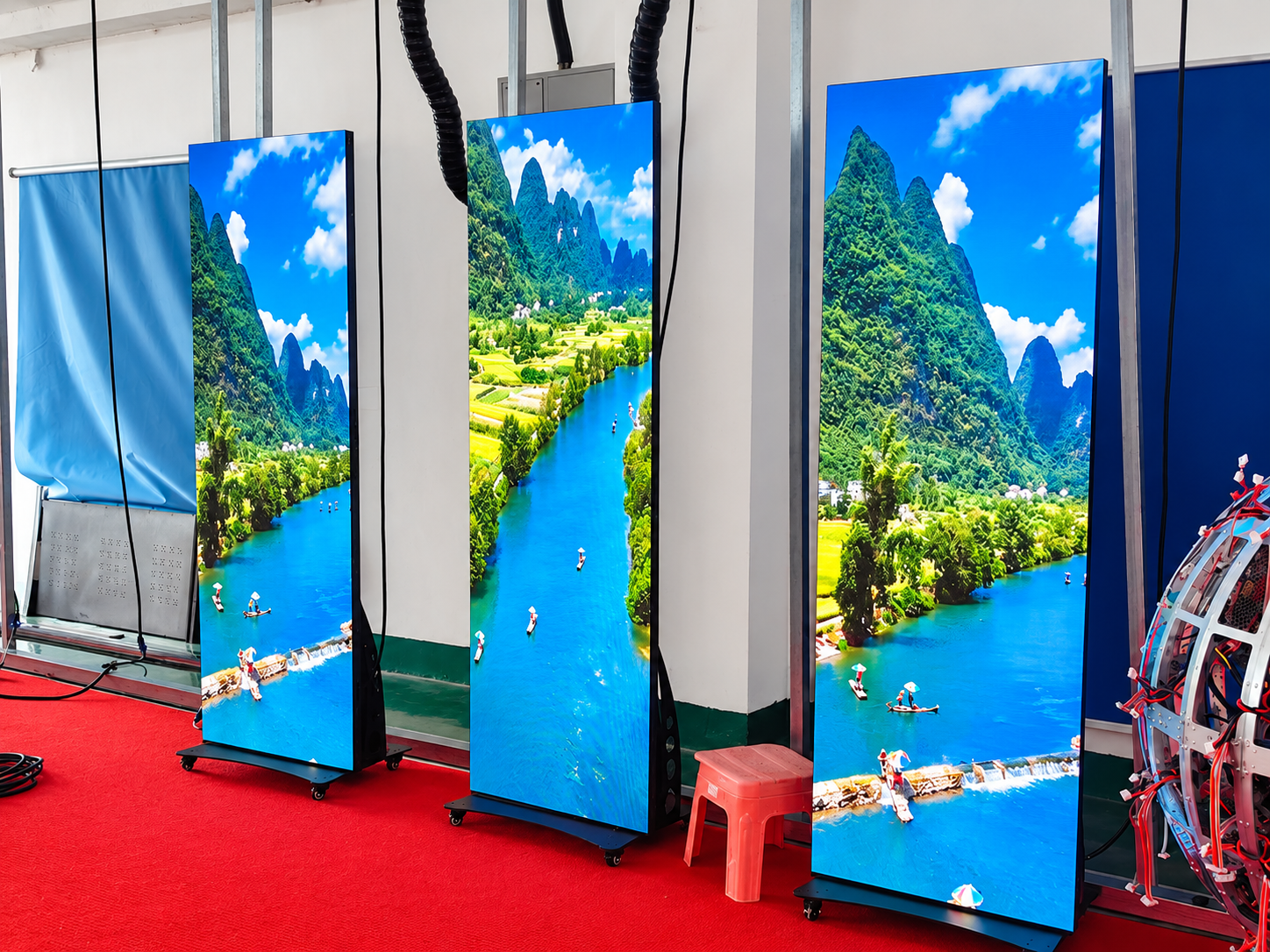
One module may look slightly darker. Another may reflect more ceiling light. A small group of panels may appear warmer or cooler when the screen shows dark gray content.
These differences are often difficult to notice when individual modules are tested separately.
Once hundreds of modules form one large LED wall, however, small differences can become very clear.
For this reason, checking COB LED display surface consistency before shipment is an important part of quality control, especially for fine-pitch indoor LED screens.
COB, or Chip-on-Board, places LED chips directly onto the board and protects the display surface with an encapsulation layer.
Compared with traditional exposed LED packages, this creates a flatter and more continuous front surface.
That smooth surface is one reason COB LED displays are often selected for meeting rooms, control centers, showrooms, command centers and other close-viewing applications.
But a continuous surface also makes differences between modules easier to notice.
For example, if two modules have slightly different black levels, they may create a visible rectangular boundary when the screen displays dark content.
The problem becomes more obvious when viewers stand close to the screen.
Black consistency is affected by more than LED brightness.
The encapsulation material, surface texture, coating process and production batch can all influence how the module looks when the LEDs are turned off.
Even if two modules use similar LED chips, their surfaces may reflect ambient light differently.
This can create a situation where the screen looks uniform when showing bright white content but uneven when displaying black or dark gray images.
Modules from different production batches can also have small differences.
For large projects, using carefully matched modules is therefore important.
A COB LED display should not only be tested in a dark production room.
The final installation environment should also be considered.
Conference rooms may have strong ceiling lights. Retail spaces may use spotlights. Control rooms may have lights positioned directly above the LED wall.
These light sources can create reflections across the screen.
During factory inspection, technicians can place the assembled display under different lighting directions and observe the surface from several viewing positions.
Look for:
bright reflective patches;
visible module boundaries;
different black shades;
uneven surface texture;
abnormal glare around certain cabinets.
A good COB screen should appear visually continuous instead of looking like a grid of separate modules.
A completely black image is useful, but it should not be the only test.
Low-gray images are often more effective for finding small uniformity problems.
Test patterns such as 5%, 10% and 20% gray can reveal differences that are almost invisible under full-white content.
Technicians should stand at both the normal viewing distance and a closer inspection distance.
The screen should also be photographed with fixed camera settings.
Using the same exposure for the entire screen makes it easier to compare different areas.
If one group of modules consistently appears brighter or darker, engineers can investigate the modules before packing the display.
For a large fine pitch COB LED display, module management is important.
Modules should be grouped according to production and calibration data instead of being randomly mixed.
During a full-screen aging test, engineers can compare neighboring modules and identify unusual areas.
If a module has a noticeably different surface appearance, replacing it before shipment is much easier than discovering the problem after installation.
Spare modules supplied with the project should also be checked.
A replacement module that works electrically but looks different from the existing screen may create a permanent visible patch.
For this reason, spare parts should ideally be prepared and calibrated together with the main screen.
A smaller pixel pitch does not automatically mean a better COB LED screen.
For example, two P1.2 COB displays may have the same nominal resolution but very different visual results.
Buyers should also consider:
surface flatness, black consistency, low-gray performance, color calibration, cabinet precision, heat management and maintenance method.
These factors work together.
The LED chip is only one part of the complete display system.
For customized installations, the cabinet structure and installation accuracy are equally important. A strong display system should combine the LED modules, control system and mechanical structure as one complete solution.
Consider a fine-pitch COB video wall prepared for a corporate meeting room.
Before shipment, the complete wall is assembled in the factory.
Engineers first display red, green, blue and white test images to check basic pixel and color performance.
They then switch to black and several low-gray images.
Room lights are turned on, and additional light is directed toward the screen from different angles.
Technicians inspect the display from the front and from both sides.
If one cabinet produces stronger reflection or a different black shade, the issue can be corrected before packing.
This simple inspection can prevent a small production difference from becoming an obvious visual problem at the customer's site.
Yes. COB technology is commonly used for fine-pitch indoor applications where viewers may stand relatively close to the screen.
The difference may come from surface coating, encapsulation, reflection or module batch variation rather than the LED chips themselves.
Yes. Testing and matching spare modules before shipment can make future replacement much easier.
No. White, black, low-gray and solid-color test images should all be used because different defects appear under different content.
At AILED Display, we focus on the complete LED display system rather than checking only individual specifications.
For COB LED display and customized LED projects, module matching, cabinet accuracy, control configuration and factory testing should be considered before the screen leaves production.
This is especially important for fine-pitch displays installed in meeting rooms, control centers, commercial spaces and other close-viewing environments.
A well-tested COB LED display should not simply light up correctly. It should look like one continuous screen from normal viewing positions.
For more LED display solutions and customized display projects, visit AILED Display at aileddisplay.com.
Copyright © 2025 by Shenzhen Ai Display Technology Co., Ltd - Privacy policy
 EN
EN
 Hot News